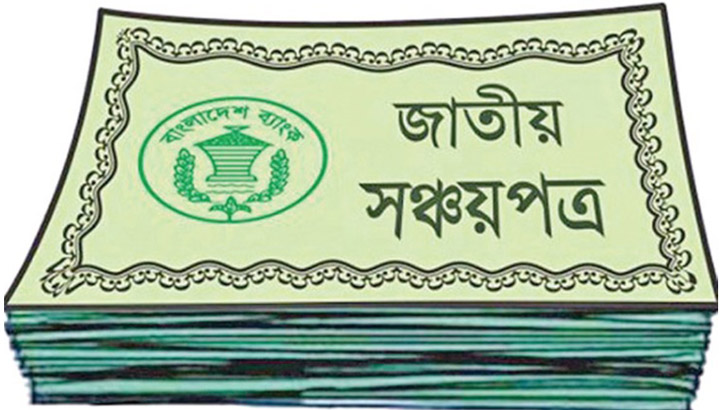
Net sales of national saving certificates (NSCs) have already crossed this fiscal
year’s target in just six months as the shrinking bank interest rate on deposits for
the expansionary monetary policy is sending savers towards the government’s
savings instruments.
Between July and December of last year, the net sales of savings instruments
stood at Tk 20,487.1 crore, according to the data from the National Savings
Directorate. The government has set a target of borrowing Tk 20,000 crore
against savings certificates for fiscal 2020-21.
At present, most of the banks are collecting deposits at less than 4 per cent while
the government is offering up to 11.3 per cent interest against the national saving
tools.
But the interest rates on deposits were supposed to be higher at this point: with
the view to implementing the single-digit interest rate on lending, the government
had fixed a 6 per cent interest rate on deposits from February last year. Then the
global coronavirus pandemic barged in and upended all plans.
With the view to steering the economy away from a steep downturn, the
Bangladesh Bank rolled out a vastly expansionary monetary policy for fiscal 2020-
21 in July last year, which flooded the market with liquidity, meaning the banks
had less of a demand for savers’ funds.
At the end of December last year, the excess liquidity in the banking sector stood
at Tk 204,700 crore, which is the biggest in at least two years, according to data
from the Bangladesh Bank.
At the same time, the government too has an incentive to sell as much of its
savings certificates that it can: the pandemic has shrunk its revenue stream and
also raised its expenditure, so it had to look elsewhere for funds.
Revenue collection in the July-December period stood at Tk 108,471 crore, which
is the lowest in recent years. The National Board of Revenue had targeted to log
in Tk 141,225 crore halfway into the fiscal year.
Savers are diverting their money to the NSCs due to the lower yield on bank
deposits, said Agrani Bank Chairman Zaid Bakht.
As of November last year, the weighted average interest rate on deposits of
banks stood at 4.6 per cent, in contrast to 5.7 per cent a year earlier.
Banks are offering very low interest against their deposits products owing to the
excess liquidity in the banking sector, said Bakht, also the research director of the
Bangladesh Institute of Development Studies.
Although the country’s stock market is having a good run, people’s confidence on
the bourse is not as high that they would consider it as an alternative to bank
deposits yet, he said.
“People always consider saving certificates as a safe investment,” he added.











-20251206083331.jpeg)





-20251205185652.webp)


-(25)-20251122062715-20251202031751.jpeg)
-(25)-20251122062715-20251204041734.jpeg)