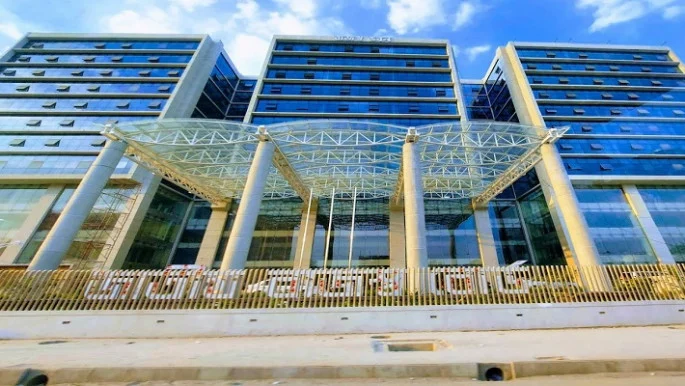
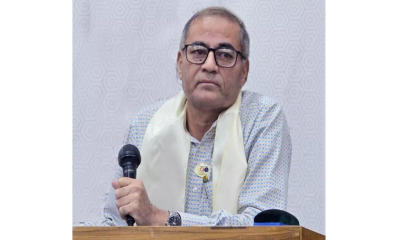
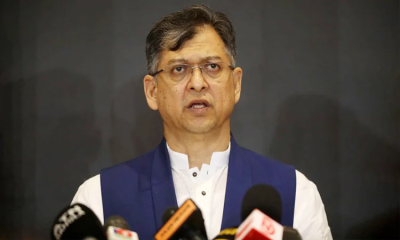
Finance Adviser Dr Salehuddin Ahmed on Tuesday said the interim government will complete the splitting process of the National Board of Revenue (NBR) before the February-12 general election.
“Time is still there. It has not happened yet, but you will see whether it happens by January or February 12. All the formalities will be completed. There is only a small issue (over it) left,” he told reporters after the meetings of the Advisers Council Committee on Economic Affairs and Advisers Council Committee on Government Purchase at the Secretariat.
The long-discussed process of separating policy formulation from tax administration at the NBR has missed the December-31 deadline.
Dr Salehuddin Ahmed also acknowledged that the separation could not be finalised by the end of 2025, despite earlier assurances, but said the process was still very much on track and awaiting completion of some remaining formalities.
The adviser looked confident when pressed further on whether the government itself was driving the process forward. “Sure,” he replied.
The reform aims to split the NBR into two distinct entities—one responsible for tax policy and another for tax collection and administration—a move that has long been recommended by development partners, economists and business leaders to improve efficiency, transparency and revenue mobilisation.
A prolonged chapter of agitation within the NBR over the government’s decision to split the revenue authority culminated in a series of protests, administrative upheavals and suspension orders that continue to reverberate across the country’s fiscal apparatus.
The controversy began in May 2025, when the interim government promulgated the Revenue Policy and Revenue Management Ordinance, 2025, abolishing the long-standing National Board of Revenue — established in 1972 — and replacing it with two separate entities: the Revenue Policy Division (RPD) and Revenue Management Division (RMD) under the Finance Ministry.
The move, aimed at separating tax policy formulation from revenue collection to boost transparency and efficiency, was justified by the government as a necessary structural reform to modernise Bangladesh’s revenue system.
The split, however, triggered intense resistance from NBR officials and employees, who argued that the ordinance was issued without adequate consultation and bypassed recommendations of the NBR Reform Committee.
Many protested the perceived expansion of administration cadre influence at the expense of tax and customs professionals.
In mid-May, the NBR Reform Unity Council, representing officers and staff from customs, income tax and VAT wings, launched a three-day work abstention, with officials laying down their pens in offices across Agargaon and regional outposts.
Protesters insisted they were not against reform per se, but demanded that changes reflect expert advice and include meaningful dialogue with stakeholders.
The agitation escalated in June, with pen-down strikes, sit-ins and threats of a ‘complete shutdown’ of all revenue offices if the ordinance was not repealed and the NBR chairman removed. Demonstrations disrupted tax, customs and VAT operations briefly, including a partial halt at Chattogram Port — Bangladesh’s busiest trade gateway.
Government response was firm. Authorities designated revenue services as ‘essential’, making strike actions unlawful, and repeatedly offered dialogue while maintaining the reform agenda.
Thousands of import-export, tax assessment and revenue collection operations were ordered to continue.
Following the unrest, several officials were suspended or placed on special duty for alleged obstruction of official duties.
In mid-2025, dozens of senior NBR officers, including advocates of the protest, were suspended — some for publicly tearing up transfer orders — and a number were sent into forced retirement.
Departmental proceedings and Anti-Corruption Commission probes were also initiated against several leaders.
While large-scale protest actions have subsided, unease persists among staff as implementation of the split continues and talks on amendments to the ordinance proceed.
The episode marks a rare and significant internal challenge within Bangladesh’s revenue administration, with long-term implications for governance and fiscal policy.




-20260107111805.webp)

-20260107070753.jpeg)
-(2)-20260102070806.jpeg)

-(25)-20251122062715-20260105041159.jpeg)



-20260103102222.webp)