


A couple of years ago, when Coldplay’s Chris Martin was going through a divorce from the actress Gwyneth Paltrow and feeling down, a friend gave him a book to lift his spirits. It was a collection of poetry by Jalaluddin Rumi, the thirteenth-century Persian poet, translated by Coleman Barks.
“It kind of changed my life,” Martin said later, in an interview.
A track from Coldplay’s most recent album features Barks reciting one of the poems: “This being human is a guest house / Every morning a new arrival / A joy, a depression, a meanness, / some momentary awareness comes / as an unexpected visitor.”
Rumi has helped the spiritual journeys of other celebrities—Madonna, Tilda Swinton—some of whom similarly incorporated his work into theirs.
Aphorisms attributed to Rumi circulate daily on social media, offering motivation. “If you are irritated by every rub, how will you ever get polished,” one of them goes. Or, “Every moment I shape my destiny with a chisel. I am a carpenter of my own soul.”
Barks’s translations, in particular, are shared widely on the Internet; they are also the ones that line American bookstore shelves and are recited at weddings.
Rumi is often described as the best-selling poet in the United States. He is typically referred to as a mystic, a saint, a Sufi, an enlightened man.
Curiously, however, although he was a lifelong scholar of the Quran and Islam, he is less frequently described as a Muslim.
The words that Martin featured on his album come from Rumi’s “Masnavi,” a six-book epic poem that he wrote toward the end of his life.
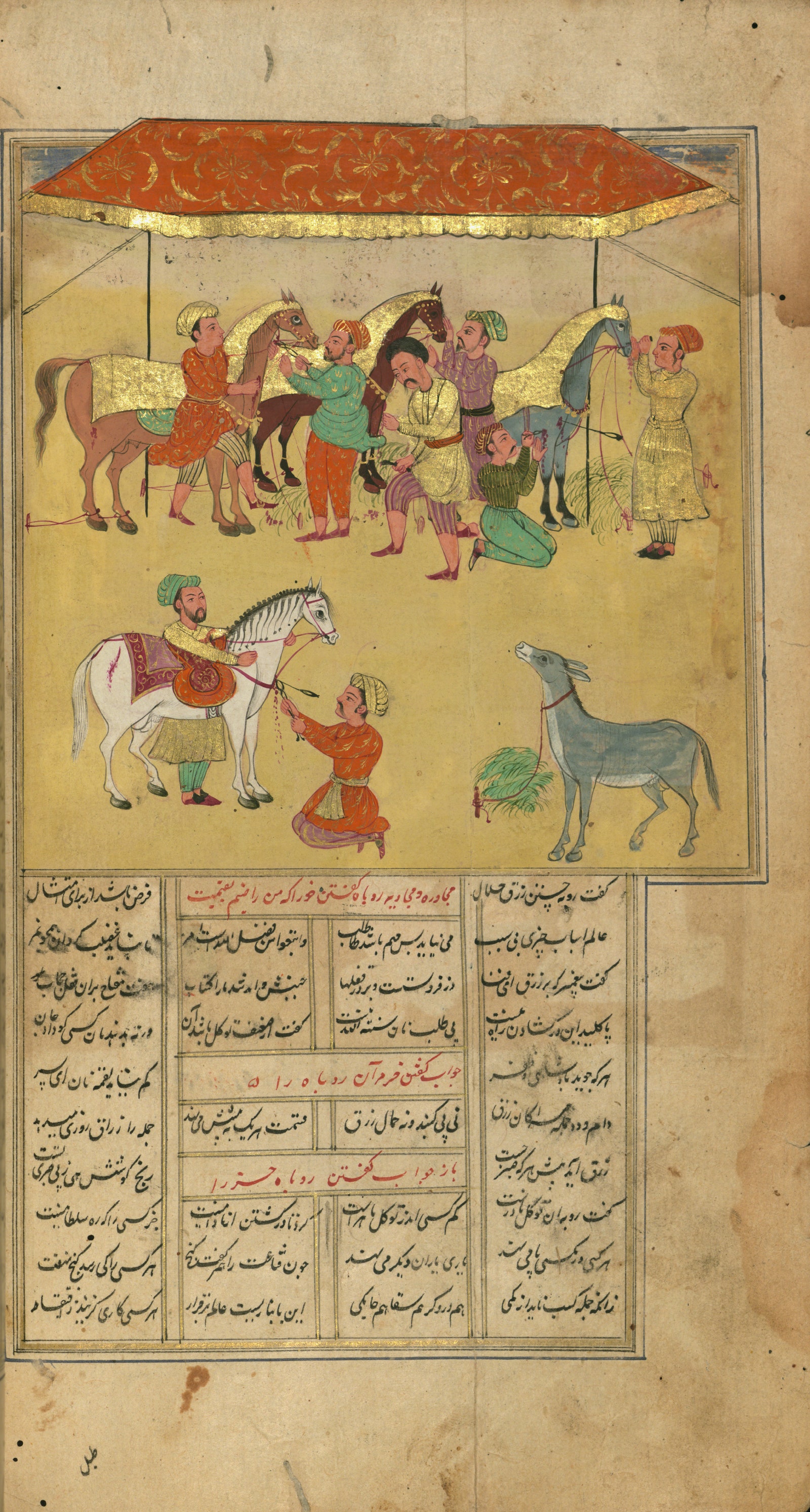
A seventeenth-century illustration for Rumi’s epic poem 'Masnavi.'
Its fifty thousand lines are mostly in Persian, but they are riddled with Arabic excerpts from Muslim scripture; the book frequently alludes to Quranic anecdotes that offer moral lessons.
Fatemeh Keshavarz, a professor of Persian studies at the University of Maryland, said that Rumi probably had the Quran memorized, given how often he drew from it in his poetry.
Rumi himself described the “Masnavi” as “the roots of the roots of the roots of religion”—meaning Islam—“and the explainer of the Quran.” And yet little trace of the religion exists in the translations that sell so well in the United States.
“The Rumi that people love is very beautiful in English, and the price you pay is to cut the culture and religion,” Jawid Mojaddedi, a scholar of early Sufism at Rutgers, said.
Rumi was born in the early thirteenth century, in what is now Afghanistan. He later settled in Konya, in present-day Turkey, with his family.
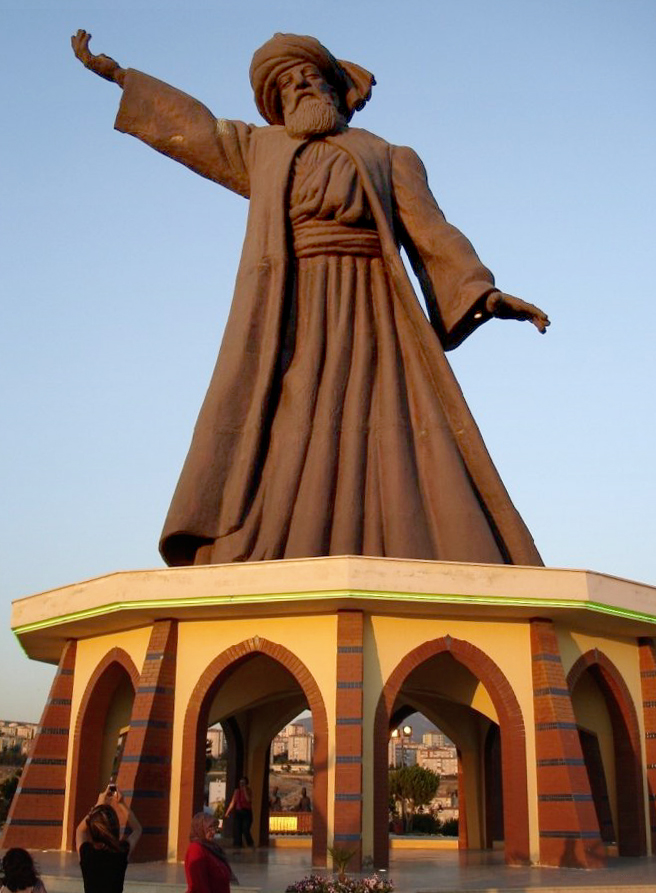
Statue of Rumi in Buca, Turkey.
His father was a preacher and religious scholar, and he introduced Rumi to Sufism. Rumi continued his theological education in Syria, where he studied the more traditional legal codes of Sunni Islam, and later returned to Konya as a seminary teacher.
It was there that he met an elder traveler, Shams-i-Tabriz, who became his mentor. The nature of the intimate friendship between the two is much debated, but Shams, everyone agrees, had a lasting influence on Rumi’s religious practice and his poetry.
In a new biography of Rumi, “Rumi’s Secret,” Brad Gooch describes how Shams pushed Rumi to question his scriptural education, debating Quranic passages with him and emphasizing the idea of devotion as finding oneness with God.
Rumi would come to blend the intuitive love for God that he found in Sufism with the legal codes of Sunni Islam and the mystical thought he learned from Shams.
Source: The New Yorker







-20260416124550.webp)




-20260416052446.webp)




-20260414132817.webp)












-20260409083432.webp)

-20260411131845.webp)