
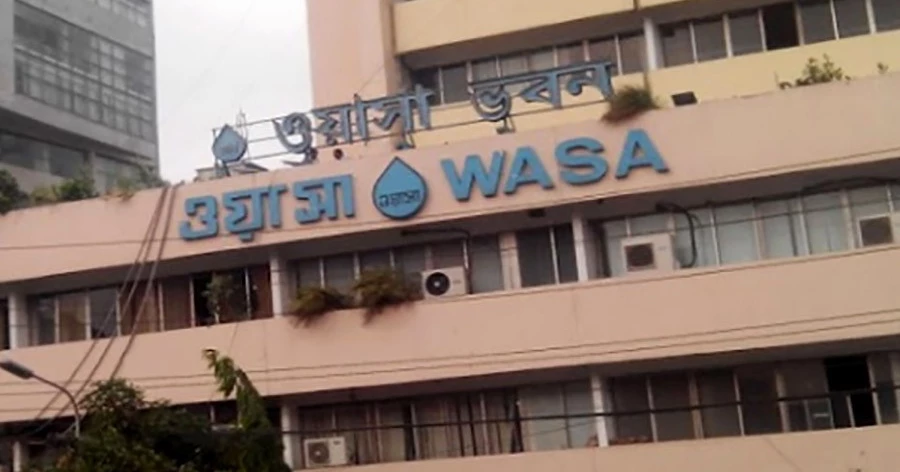
Dhaka Water Supply and Sewerage Authority (DWASA) is set to establish a dedicated Training and Research Academy aimed at reducing its long-standing dependence on costly local and foreign consultancy services.
The proposed project, titled ‘Dhaka Wasa Training and Research Academy Establishment’, will be implemented at Mirpur Senpara Parbata Mouza in the capital at an estimated cost of Tk 721.42 crore.
Dhaka Wasa will execute the project under the Local Government Division between October 2025 and June 2031.
Officials said the project will gradually reduce Dhaka Wasa’s reliance on external consultants by creating a skilled pool of in-house professionals capable of planning, operating and maintaining complex systems.
According to official documents, the project is designed to build strong in-house technical capacity at a time when Dhaka Wasa is implementing complex, technology-driven infrastructure projects under its Water Master Plan and Sewerage Master Plan.
Dhaka Wasa is undertaking several major projects including the construction of two water treatment plants and one sewage treatment plant, alongside the introduction of 145 District Metered Areas across the city to reduce system loss and ensure pressurised and uninterrupted water supply.
Of these, 89 DMAs have already been established while the remaining ones are under construction.
At the same time, advanced technologies such as smart water meters and Supervisory Control and Data Acquisition systems are being introduced for centralised monitoring and data management.
Officials said Dhaka Wasa’s officers and staff do not yet have adequate expertise to operate and manage these modern systems effectively.
Almost all planning, implementation, monitoring and optimisation activities are being carried out by domestic and international consultancy firms, making projects expensive and limiting long-term institutional learning.
“Due to a lack of technical knowledge and proper training facilities, Dhaka Wasa has no alternative but to rely on consultants for specialised tasks like DMA management, leak detection, SCADA operation and smart metering. This significantly raises project costs and weakens internal capacity,”a senior official told UNB.
Dhaka Wasa currently has a training centre but its infrastructure and human resources are inadequate for advanced training and research.
Opportunities for gaining modern technological knowledge and hands-on experience remain very limited.
Although Dhaka Wasa operates microbiology and chemical laboratories mainly to test water quality, meaningful research to improve water quality standards is minimal because of the absence of proper research facilities and trained manpower.
The proposed academy aims to address these challenges by establishing an international-standard training and research institute focused on water supply and sewerage services.
Major components of the project include the construction of a training and research centre, dormitory facilities, parking areas and a pilot plant, along with the procurement of modern training and research equipment. The project also allocates funds for architectural design, construction supervision and specialised technical consultancy during the initial phase.
The financing plan includes Tk 90 crore from government funds, Tk 571.42 crore in project loans and Tk 60 crore from Dhaka Wasa’s own resources.
Once operational, the academy is expected to provide advanced training to Dhaka Wasa officials and employees in areas such as low-cost water and sewage treatment technologies, DMA establishment, leak detection, smart metering and SCADA-based system management.
Beyond Dhaka Wasa, the academy is also planned as a regional knowledge-sharing platform. It will offer training and capacity-building support to water and sewerage service providers from across Bangladesh and South Asia.
“This institute will not only improve Dhaka Wasa’s operational efficiency but also help position Bangladesh as a regional centre for water management training and research,” said an official.
The Planning Commission has already endorsed the proposal noting that its successful implementation will significantly enhance the knowledge and skills of officials working in water supply and sewerage services.

















-20260828064640.webp)