

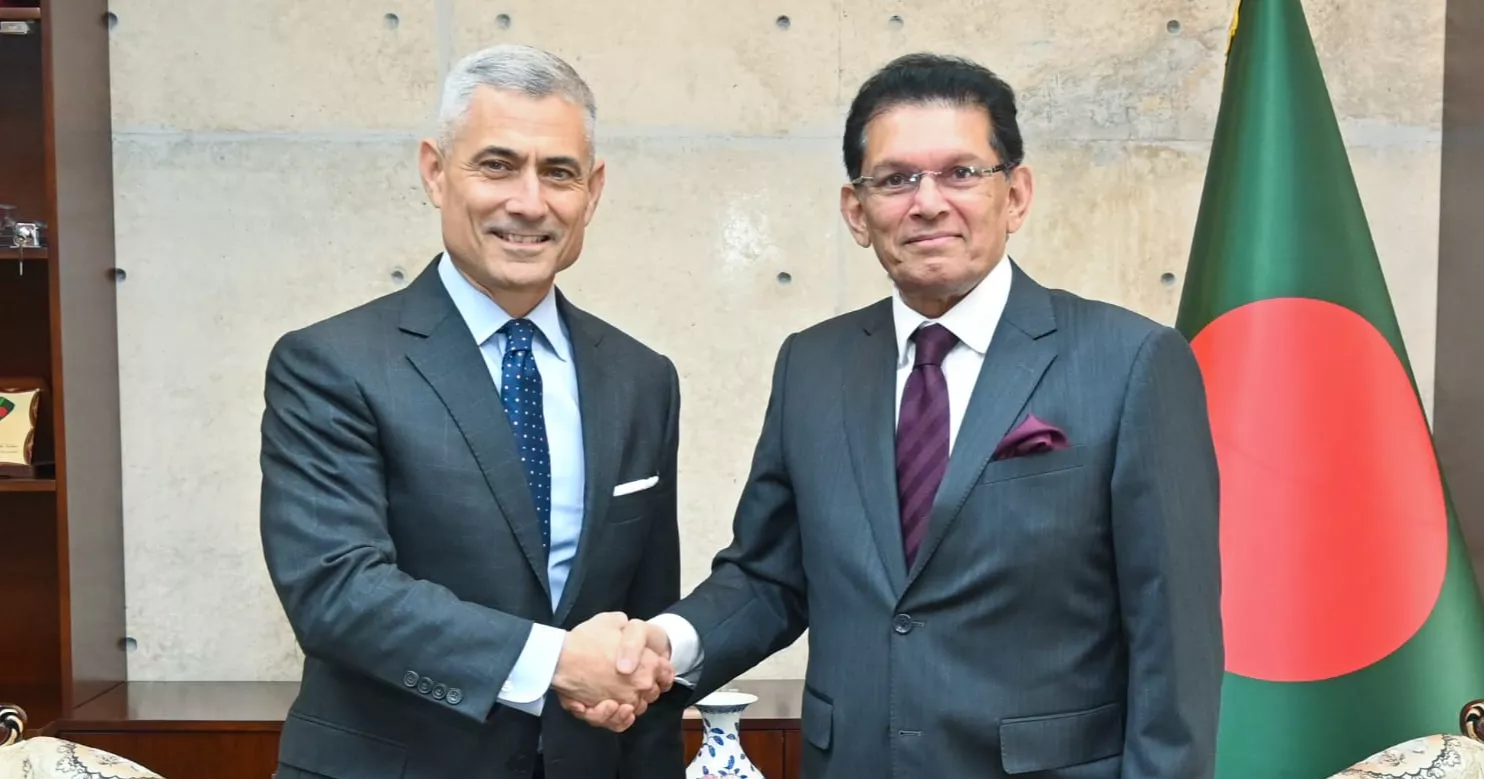
Seeking an early resolution to the ongoing crisis in the Middle East, Bangladesh on Wednesday conveyed to the US that it is difficult for a country like Bangladesh to bear the economic impact of this war if it lasts longer and spreads further.
“We have discussed the crisis in the Middle East. I told him (US Assistant Secretary S Paul Kapur) that two of our Bangladeshis have lost lives and seven others have been injured. If this war is prolonged or spreads, this fear may increase further,” Foreign Minister Dr Khalilur Rahman told reporters at the Ministry of Foreign Affairs after his meeting with the US top diplomat.
The US Assistant Secretary of State for South and Central Asian Affairs, who arrived in Dhaka on Tuesday night from New Delhi, is now paying a two-day visit.
Briefing the reporters in the afternoon, Dr Rahman said they conveyed to the US official that they should try to resolve this conflict - this problem through dialogue as soon as possible by giving diplomacy opportunity.
As the recent escalation in the Middle East came up during the exchange, the Foreign Minister stressed the need for exercising restraint by all parties and urged early resolution of the conflict through dialogue and diplomatic means in order to minimise loss of life, prevent further destabilisation in the region and beyond.
During the briefing, a journalist asked whether the US Assistant Secretary of State had said anything about when the war would end.
In response, the Foreign Minister said, "It is not even completely in their hands when the war will end. No one can say that."
When the journalist commented in response that "they have started it," Dr Rahman said, "No, no - that cannot be a question."
Responding to another question, Dr Rahman said defence matters were not discussed during the meeting and that neither GSOMIA nor ACSA was mentioned.
“There has been no discussion with me regarding defence cooperation,” he said, adding that while the Indo-Pacific issue came up but it was not discussed in detail.
The Foreign Minister said Bangladesh will review its overall Indo-Pacific Policy and reiterated that the country will not enter into any military alliance.
During the discussion, both sides reaffirmed their commitment to further strengthening bilateral relations, including economic engagements, based on mutual respect and shared interests.
Dr Rahman emphasised the ‘Bangladesh First’ policy of the current government under the leadership of Prime Minister Tarique Rahman.
He further highlighted Bangladesh’s approach to maintaining robust relations with regional and global partners to promote national interests and shared prosperity.
Assistant Secretary Paul Kapur expressed happiness at the peaceful, free and festive general election in Bangladesh and felicitated the new government led by Prime Minister Tarique Rahman on the assumption of its responsibilities.
He also mentioned the congratulatory letter of US President Donald Trump addressed to Prime Minister Tarique Rahamn, and expressed the confidence that the ties between two countries will grow stronger in the coming days.
Paul Kapur also underscored the importance of implementing the provisions of the agreement on Reciprocal Trade to foster greater bilateral trade and investment.
The Foreign Minister reiterated the government’s commitment to policy continuity, particularly in the economic domain.
The two sides also discussed the Rohingya issue.
The Foreign Minister thanked the United States for its continued humanitarian support for the Rohingyas and sought sustained international support for a durable solution to the crisis.
Both sides expressed optimism that regular high-level engagements and institutional dialogues would continue to deepen Bangladesh-US relations in the years ahead.
Prior to this meeting, Paul Kapur had a brief meeting with the State Minister, Shama Obaed Islam.

-20260401052525.png)



-20260414132817.webp)









-20260409083432.webp)
-20260411131845.webp)
-20260412180017.jpg)