

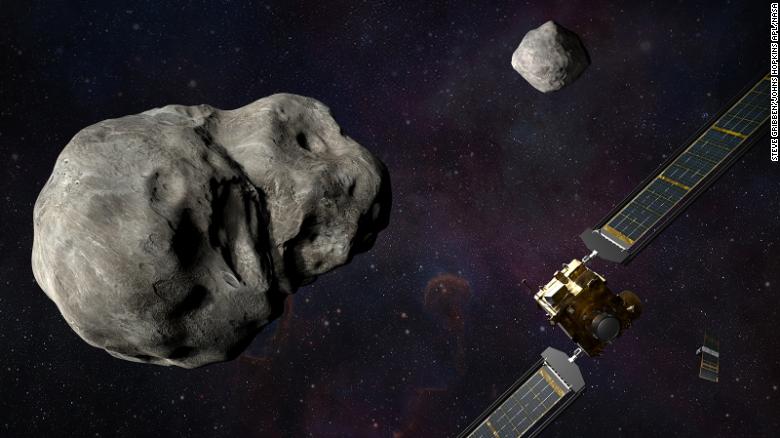
A spacecraft that will deliberately crash into an asteroid is preparing to launch.
The DART mission, or NASA's Double Asteroid Redirection Test, will lift off at 10:20 p.m. PT on November 23 aboard a SpaceX Falcon 9 rocket from Vandenberg Space Force Base in California.
After launching in November, NASA will test its asteroid deflection technology in September 2022 to see how it impacts the motion of a near-Earth asteroid in space.
The target of this asteroid deflection technology is Dimorphos, a small moon orbiting the near-Earth asteroid Didymos. This will be the agency's first full-scale demonstration of this type of technology on behalf of planetary defense.
Near-Earth objects are asteroids and comets whose orbits place them within 30 million miles of Earth. Detecting the threat of near-Earth objects, or NEOs, that could potentially cause grave harm is a primary focus of NASA and other space organizations around the world.
Didymos and Dimorphos
Two decades ago, a binary system involving a near-Earth asteroid was found to have a moon orbiting it, dubbed Didymos. In Greek, Didymos means "twin," which was used to describe how the larger asteroid, which is nearly half a mile across, is orbited by a smaller moon that is 525 feet in diameter. At the time, the moon was known as Didymos b.
Kleomenis Tsiganis, a planetary scientist at the Aristotle University of Thessaloniki and a member of the DART team, suggested that the moon be named Dimorphos.
"Dimorphos, which means 'two forms,' reflects the status of this object as the first celestial body to have the 'form' of its orbit significantly changed by humanity — in this case, by the DART impact," said Tsiganis. "As such, it will be the first object to be known to humans by two, very different forms, the one seen by DART before impact and the other seen by the European Space Agency's Hera, a few years later."
In September 2022, Didymos and Dimorphos will be relatively close to Earth and within 6,835,083 miles (11 million kilometers) of our planet. It's the perfect time for the DART mission to occur.
DART will deliberately crash into Dimorphos to change the asteroid's motion in space, according to NASA. This collision will be recorded by LICIACube, a companion CubeSat or cube satellite provided by the Italian Space Agency. The CubeSat will travel on DART and then be deployed from it prior to impact so it can record what happens.
"Astronomers will be able to compare observations from Earth-based telescopes before and after DART's kinetic impact to determine how much the orbital period of Dimorphos changed," said Tom Statler, DART program scientist at NASA Headquarters, in a statement. "That's the key measurement that will tell us how the asteroid responded to our deflection effort."
A few years after the impact, the European Space Agency's Hera mission will conduct a follow-up investigation of Didymos and Dimorphos.
While the DART mission was developed for NASA Planetary Defense Coordination Office and managed by the Johns Hopkins University Applied Physics Laboratory, the mission's team will work with the Hera mission team under an international collaboration known as the Asteroid Impact & Deflection Assessment, or AIDA.
"DART is a first step in testing methods for hazardous asteroid deflection," said Andrea Riley, DART program executive at NASA Headquarters, in a statement. "Potentially hazardous asteroids are a global concern, and we are excited to be working with our Italian and European colleagues to collect the most accurate data possible from this kinetic impact deflection demonstration."



-20260306071206.webp)
-20260228080513.webp)
-20260224065127.webp)








-20260311074922.jpg)














-20260308071814.webp)

-20260307073636.webp)