

Scientists have found new evidence that the Moon is still geologically active, overturning the long-standing belief that its surface has remained largely unchanged for billions of years.
Although the Moon does not have plate tectonics like Earth, researchers say internal stresses in its crust continue to shape the surface. These forces create features such as lobate scarps—small ridges formed when the crust is compressed and pushed over itself along faults. Most of these scarps are found in the Moon’s highlands and formed within the last billion years.
Earlier research by planetary scientist Tom Watters showed that the Moon is slowly shrinking as it cools, a process that explains many of these scarps. However, scientists later realized that some young tectonic features could not be fully explained by this process alone.
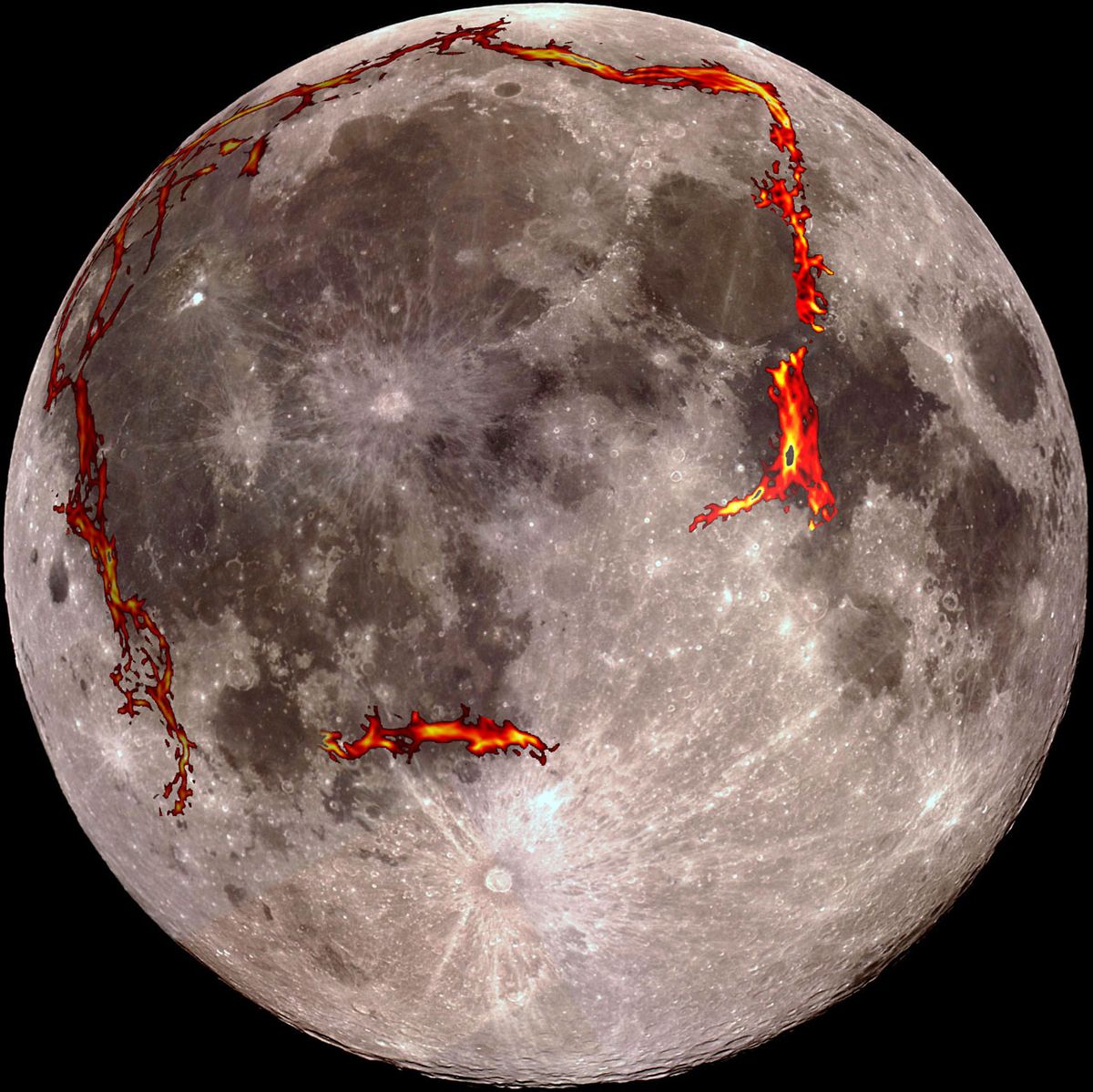
In a new study, researchers identified another type of tectonic structure known as Small Mare Ridges (SMRs). These ridges form through similar compression but are found only in the Moon’s maria the darker, volcanic plains visible from Earth.
Watters and his team mapped SMRs across the Moon’s nearside maria and found they are far more widespread than previously known. Researcher Cole Nypaver said this is the first time scientists have confirmed that young tectonic features are common throughout the maria, not just the highlands.
The team created the first complete catalog of SMRs, identifying 1,114 new ridge segments. This brings the total number of known SMRs on the Moon to 2,634. The study estimates their average age at about 124 million years, close to the estimated age of lobate scarps, making both among the Moon’s youngest geological features.
Researchers also found that SMRs and lobate scarps form along similar fault systems and sometimes even connect, suggesting they share the same underlying cause global contraction of the Moon.
“These young ridges give us a global picture of a Moon that is still contracting and evolving,” Watters said.
The findings, published in the Planetary Science Journal, offer fresh insight into the Moon’s internal structure, its seismic activity, and the possibility of future moonquakes important information for upcoming lunar missions.








-20260826073100.jpg)


-20260825123740.webp)




-20260825070038.webp)







-20260824112248.jpg)



-20260823124453.webp)