
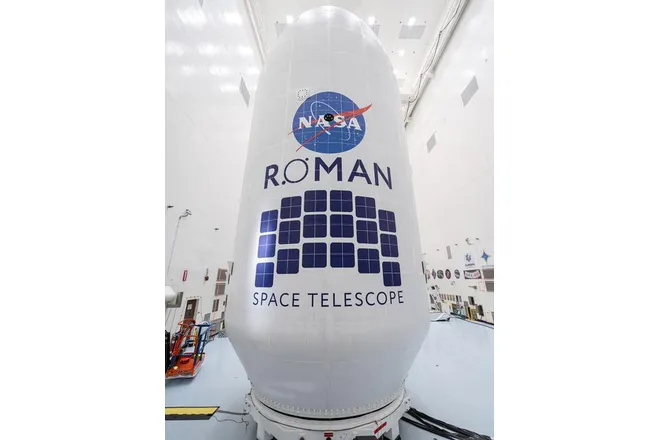
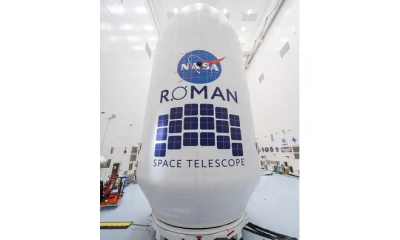
NASA’s Nancy Grace Roman Space Telescope has begun its journey into space after a SpaceX Falcon Heavy launch Sunday, opening the way for a sweeping survey of planets, galaxies and the mysterious forces shaping the universe.
The $4.3 billion telescope lifted off shortly after sunrise from NASA’s Kennedy Space Center and is headed for an observation point about 1 million miles (1.6 million kilometres) from Earth. It will take more than three months to reach its destination, where NASA’s James Webb Space Telescope is also stationed.
Once operational, Roman is expected to deliver the widest view of the universe ever achieved from space. NASA estimates it could detect thousands of supernovae, tens of thousands of planets, billions of galaxies and tens of billions of stars.
Roman’s field of view is more than 100 times wider than Hubble’s, allowing it to survey enormous areas of the sky far more quickly. NASA scientists say observations that would take Hubble roughly a century could be completed by Roman in about a month.
A key mission will be searching for planets beyond the solar system. Roman will scan huge numbers of stars and galaxies to identify promising planetary systems, which can then be examined in greater detail by Webb.
The telescope will also investigate dark matter and dark energy, which scientists believe together account for most of the universe. By mapping vast numbers of galaxies, researchers hope to better understand cosmic expansion and the invisible forces behind it.
Roman carries a wide-field infrared camera with sensitivity comparable to Hubble but capable of surveying the sky around 1,000 times faster. An experimental coronagraph will also attempt to block starlight so that faint planets orbiting distant stars can potentially be observed directly.
The mission is designed to complement Hubble and Webb, as well as the European Space Agency’s Euclid spacecraft and the Vera C. Rubin Observatory in Chile.
The launch also marks a milestone for NASA: Roman is the agency’s first space telescope named after a woman. Nancy Grace Roman, NASA’s first chief astronomer, played a major role in advocating for space-based astronomy and helped lay the groundwork for the Hubble Space Telescope.
The telescope’s nearly 8-foot (2.4-metre) primary mirror is the same size as Hubble’s and was originally manufactured for a US spy-satellite programme before being donated to NASA.
SpaceX’s two reusable Falcon Heavy side boosters successfully returned to Earth and landed vertically shortly after launch.















-20260824112248.jpg)

-20260823124453.webp)