

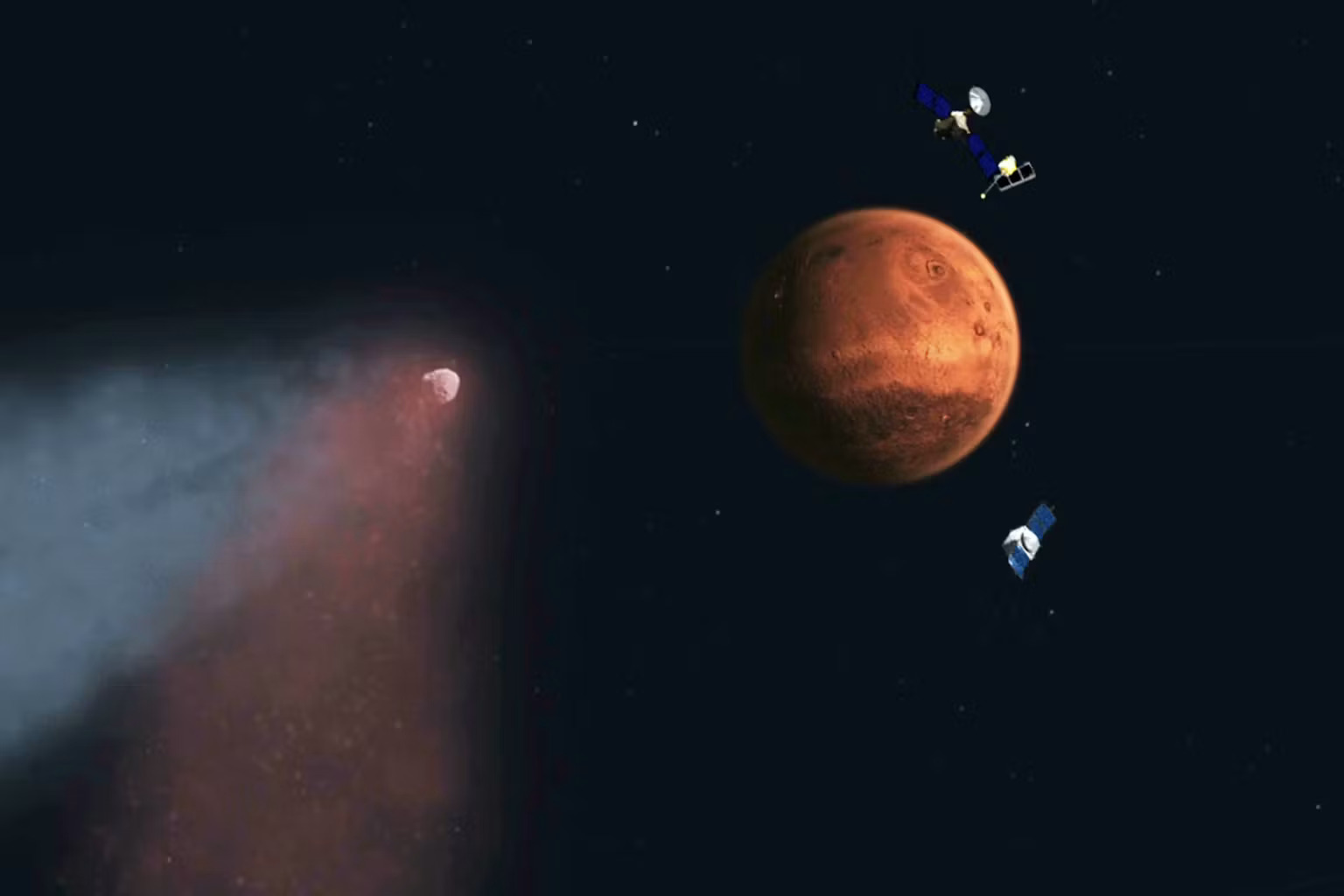
Japan is preparing to send a spacecraft to Mars’ moons in a mission that could offer new clues about how the Solar System formed and how the ingredients for life reached Earth.
The Martian Moons eXploration (MMX), led by the Japan Aerospace Exploration Agency (JAXA), is due to launch from Tanegashima Space Center in the coming months.
The mission will spend about three years around Mars and attempt to land on Phobos, where it will collect at least 10 grams of surface material.
A small rover named IDEFIX, developed with French partners, will study the surface of Phobos.
MMX will also observe Deimos, Mars’ other moon, before sending a capsule back to Earth for an expected landing in Australia around 2031.
Scientists hope samples from Phobos will help settle a long-running question over the origin of Mars’ two moons.
One theory suggests they were created from debris after a large object struck Mars. Another holds that they are asteroids captured by the planet’s gravity.
Resolving the mystery could provide insight into how water, organic compounds and other volatile materials moved from the outer Solar System toward the rocky planets, potentially helping scientists understand how habitable conditions developed.
“If Phobos and Deimos are indeed remnants of these early delivery systems, they may hold clues to the origins of life itself, or to be more correct, to the transport of the materials that were key to the emergence of life on rocky planets,” said Patrick Michel, a French astrophysicist involved in the IDEFIX project.
The mission also has a practical goal. JAXA says it will test technologies that could eventually allow Phobos to serve as a kind of natural space station and support future crewed missions to Mars.
Landing on Phobos presents its own engineering challenges because its gravity is extremely weak.
Akinari Uehara, an engineer at Mitsubishi Electric, said the spacecraft’s landing legs had to be designed to absorb the impact and keep the probe from falling over.
Japan has already gained experience in difficult landings and sample-return missions.
Its SLIM lunar lander tipped over after touching down on the Moon in 2024 but continued sending data. In 2020, JAXA’s Hayabusa-2 returned 5.4 grams of rock and dust from an asteroid hundreds of millions of kilometres from Earth.
MMX is being developed with France’s CNES, Germany’s DLR, NASA, the European Space Agency and a number of universities and technology companies.
Japan is not alone in pursuing Mars samples. NASA’s Perseverance rover has already collected material on Mars for a planned return mission, although the programme has effectively been cancelled by the administration of US President Donald Trump following a congressional vote in January.
China’s Tianwen-3 mission is another competitor.
Beijing plans to launch it around 2028 and return Mars samples to Earth around 2031, potentially allowing China to bring back Martian material before Japan’s MMX mission.
China previously achieved a major milestone with Tianwen-1, which successfully landed the Zhurong rover on Mars in 2021.















-20260906063831.webp)