
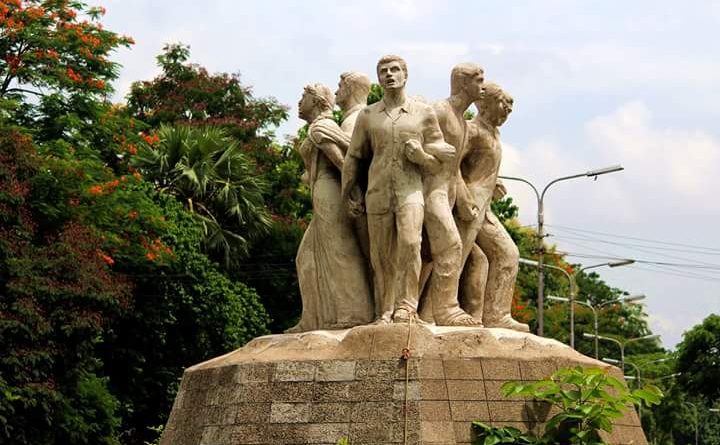
Anti-terrorism Raju Memorial sculpture popularly known as Raju Sculpture near Teachers Students Center (TSC) is one of the most familiar structures at Dhaka University. It has become the epicenter of the anti-democratic and anti-terrorism movements since its inception in 1997.
Students-Teachers protesting in front of it; is an everyday scenario of the massive structure. Maybe somebody can say that “a paper seems imperfect without having a picture of protest procession in front of the sculpture.”
Student movements and the sculpture became integral over time; you could hardly find movement without having its part after its structurization.
People who are interested in Student movements’ history of Bangladesh since the late 90s are highly fascinated with this concrete made structure. Although the installation is made of concrete, it has captured the history and feelings of millions of people for decades.
The structure was installed in the memory of the martyrs of the anti-terrorism movement including Moin Hossain Raju and named after Raju.
Raju was gunned down near where the sculpture now stands on 13 March 1992 while protesting terrorism in the name of student politics on campus.
Professor Dr. AK Azad Chowdhury, then Vice-Chancellor of Dhaka University, inaugurated the sculpture on 17 September 1997. The sculpture was made by sculptor Shyamol Chowdhury with the assistance of Gopal Paul and financed by ex teacher of Dhaka University named Atauddin Khan and Lion Nazrul Islam Khan Badal. The whole procedure was supervised by Bangladesh Students Union, as per the nameplate.
This sculpture consists of a statue of 7 men and a woman who are standing together holding each other’s hands. Year after year, it became a symbol of counter-terrorism to the people of the country and flow the message against all kinds of terrorism.
What actually happened that day?
According to the data found on different websites, with the fall of Ershad, both Awami League and BNP were trying to exert dominance on the Dhaka University campus. By 1992, Dhaka University was rife with clashes between the student wings of the above-mentioned parties, often violent and involving shootings.
On 13 March 1992, suddenly a clash broke out between the activists of Chhatra League and Chhatra Dal over establishing influence on campus. The bullets rocked the campus and everything froze for a while then Raju came out on the road and organized all comrades of his political party to protest against campus viciousness.
All of a sudden a merciless bullet hit Raju leaving him seriously injured and the Dhaka University ground stained with his blood. He was rushed to the Dhaka Medical College Hospital, he breathed his last at 10.30 pm. Everyone who was present there broke down in tears.
“Raju died in protest of a brand of student politics which was about exerting power, which was about dominance—in short, terrorism in educational institutions in the name of student politics. Since then, this has come to define mainstream student politics—clashes, fights, wielding arms, shootings, both intra- and inter-party. And, while with the change in political circumstances, clashes between BCL and Chatra Dal have almost vanished, its place has now been taken over by BCL factions fighting amongst themselves for superiority or terrorising general students simply because they can,” Abdullah Mahmud Khan, then a student of the university and an activist of Chhatra Union, said in an interview.
Who was Raju?
Moin Hossain Raju, then a student of Soil Science department at Dhaka University, was an executive member of the Bangladesh Students Union. He was born on 29 th July 1968 in Barisal.
Arriving in Dhaka in 1987, Raju became involved in politics with Bangladesh Students Union. After getting admitted to Dhaka University he became very active and he played a lionhearted role during the anti-autocratic agitations of 1990.
In recognition of his talent, patriotism, and contribution to the party he was made an executive member of Bangladesh Students Union.
He was conscious of the socio-political circumstances of Bangladesh and often discussed it with his friends. Besides politics and studies, he was passionate about painting and reciting poems.




-20260622093044.jpg)

-20260622074004.jpg)


-20260625073308.webp)