

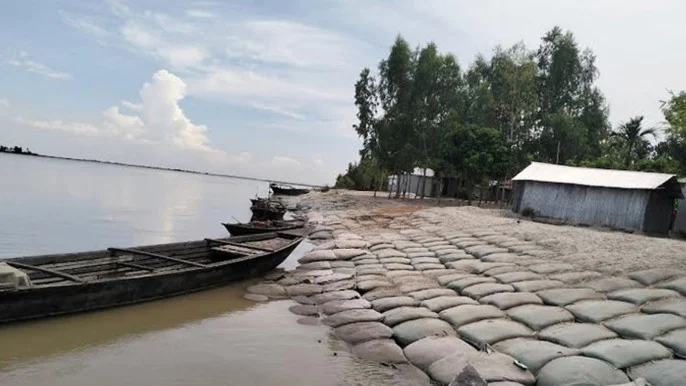
Fresh erosion along the shifting banks of the Brahmaputra has left at least 50 families homeless in northern Bangladesh over the past week, with many more on the verge of displacement.
The worst-hit areas are Sukherbati and Ghughumari villages in Char Shaulmari union, where locals said around 400 metres of homesteads and vast tracts of cropland have already been devoured by the river.
On the ground, residents were seen scrambling to dismantle and relocate their homes and belongings to safer areas. While some families have taken shelter with relatives or moved to nearby ადგილ, others remain in precarious conditions as cracks inch dangerously close to their houses.
“We have lost everything to the river. I don’t know where to go or how to rebuild my life,” said Sirajul Islam, 45.
Kashem Ali, 55, echoed the despair: “Our land and houses are disappearing one by one. We are becoming destitute.”
Experts attribute the escalating erosion to a mix of seasonal and structural factors. Professor Shafiqul Islam, president of the Kurigram district Char Development and Implementation Organisation, said erosion typically intensifies during the dry season when water levels in the Brahmaputra recede.
“The narrowing of the river channel and weak soil along the banks are accelerating the erosion,” he said, urging authorities to take immediate steps to rehabilitate affected families.
Local representatives warned that the situation could deteriorate further without urgent intervention. Former Roumari upazila parishad chairman Iman Ali said the issue has been raised with State Minister for Water Resources Farhad Hossain Azad, seeking prompt action.
Rakibul Hasan, executive engineer of the Bangladesh Water Development Board in Kurigram, said a proposal has been submitted to the Planning Ministry to control erosion along a 16.5-kilometre stretch — from Saheber Alga in Ulipur to Kodalkati in Char Rajibpur.
The project, estimated to cost Tk 8.5 crore, aims to establish permanent river control measures. “If approved, it will help mitigate erosion effectively,” he said.
For now, affected families remain in distress, fearing that without swift and effective measures, the erosion could intensify and trigger a broader humanitarian crisis — a recurring reality for communities living along the fragile banks of the Brahmaputra.






-20260724111642.jpg)










-20260726065059.jpg)










-20260720043233.jpg)