

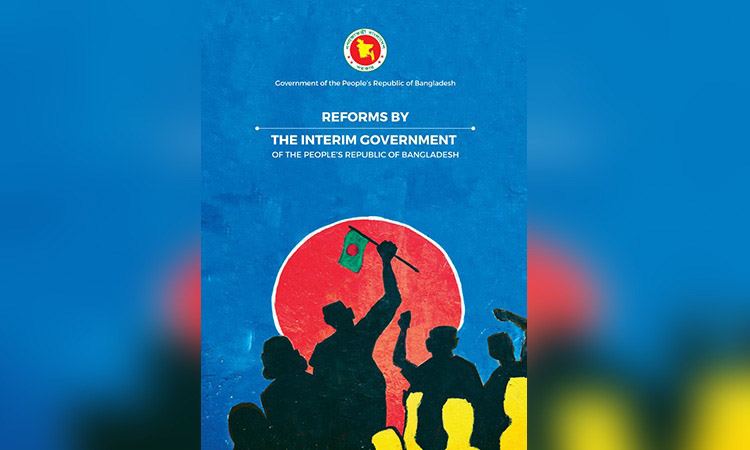
The interim government has published a book titled Reform Book, highlighting the key reform steps taken since it assumed office in August 2024.
The Chief Adviser’s Press Wing shared the information on Thursday, saying the book gives short and clear descriptions of the reform initiatives carried out during the government’s tenure.
According to the press wing, the reforms began in the aftermath of the July Uprising, when widespread protests led by young people forced an end to nearly 16 years of authoritarian rule. The movement resulted in the formation of an interim government at a time when the country was facing deep economic, institutional and democratic crises.
The government said it inherited a weakened state marked by corruption, financial mismanagement and political control over key institutions. Public funds had been looted, banks were burdened with large unpaid loans, and regulatory bodies had lost independence. Law enforcement agencies and the judiciary, the press wing said, had been used for political purposes, while elections, media freedom and civil society had lost credibility.
After taking office, the interim government formed several Reform Commissions made up of experts from different sectors. Based on their recommendations and its own initiatives, the government introduced legal and institutional changes that could be completed within its limited term.
In the last 18 months, the interim government has passed around 130 laws and taken more than 600 executive decisions. The press wing said about 84 percent of these measures have already been implemented.
The government reported progress in the economy and foreign relations, including new trade agreements and improved ties with key international partners. It said steps were taken to reduce trade barriers, improve diplomatic balance, and secure economic benefits for Bangladesh.
Accountability measures were also highlighted. Anti-corruption cases have been filed against hundreds of former politicians and officials, with large amounts of assets frozen or seized. Reforms in the banking sector, procurement system and statistical reporting were introduced to improve transparency and oversight.
Law enforcement reforms included disciplinary action against more than 1,200 officers and the introduction of human rights–focused training. The Rapid Action Battalion was restructured and renamed the Special Intervention Force.
Judicial reforms placed courts fully under the Supreme Court to reduce executive influence, while media freedom was restored by withdrawing politically motivated cases against journalists and allowing previously banned outlets to operate again.
The press wing said inclusive political dialogue was held throughout the transition, leading to the July Charter, a proposed framework for constitutional reforms that will be placed before the public in a referendum.
While acknowledging that much work remains, the interim government said the reforms mark a clear break from authoritarian rule and the beginning of a governance system aimed at serving citizens rather than controlling them.



-20260811071247.jpg)










-20260811063730.jpg)










-(22)-20260805184343.jpeg)