
Nobel laureates from around the world have issued a joint declaration calling for urgent international action to address the growing risks posed by artificial intelligence and nuclear weapons, warning that the combination presents an unprecedented threat to humanity.
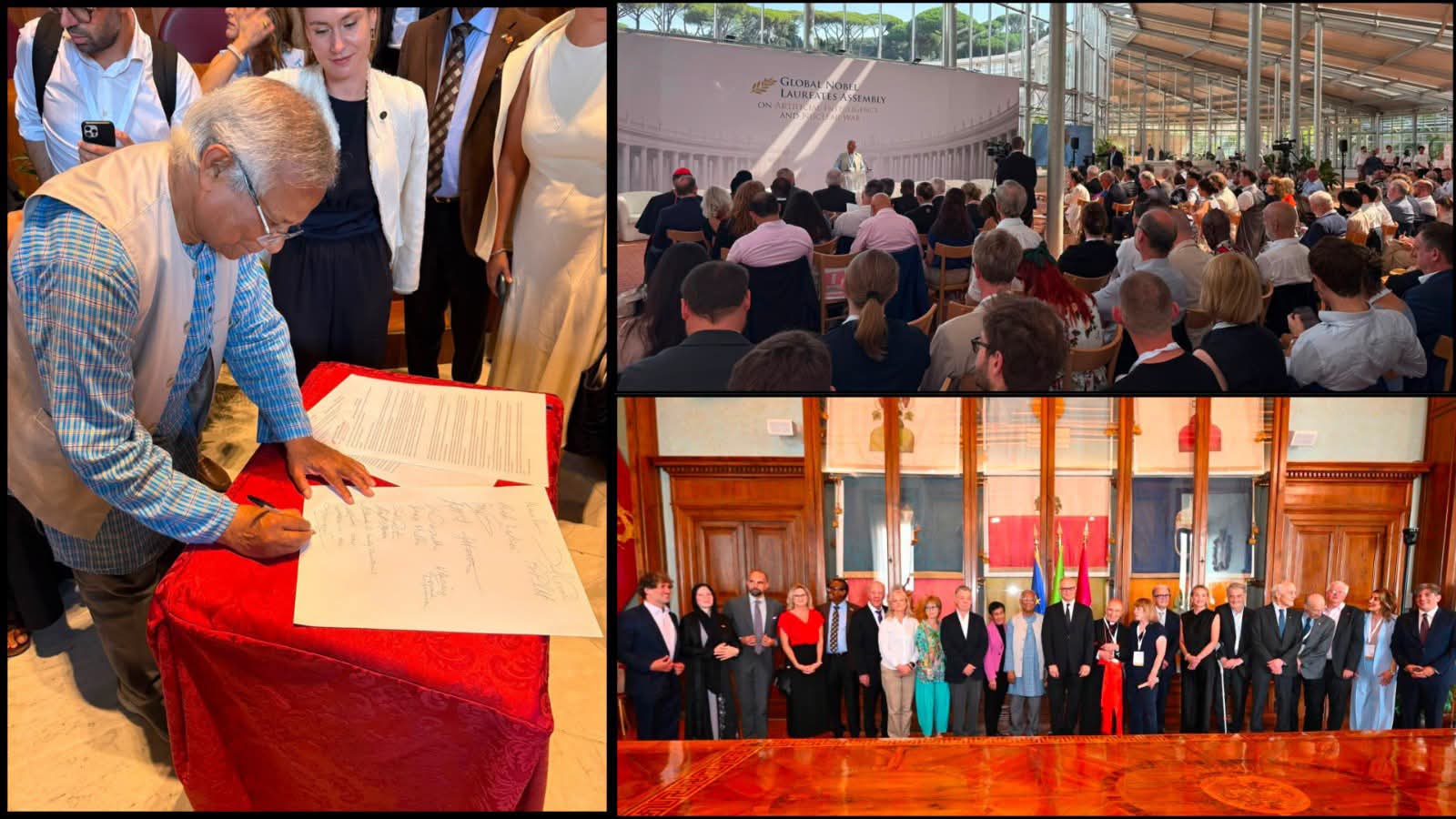
The declaration, titled "Humanity at the Threshold," was adopted at the conclusion of the three-day Global Nobel Laureates Assembly on Artificial Intelligence and Nuclear War in Rome.
Professor Muhammad Yunus joined fellow Nobel Prize winners, including Romano Prodi, Jody Williams, Maria Ressa, Denis Mukwege and Juan Manuel Santos, in endorsing the declaration, according to a press release.
The gathering began at Borgo Laudato Si` in Castel Gandolfo, where Yunus delivered the opening address alongside senior Vatican officials.
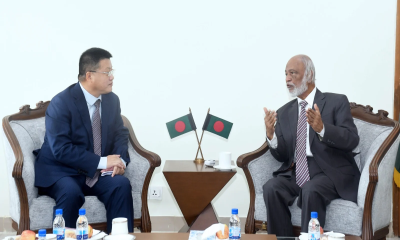
During the assembly, he also participated in a high-level discussion on the role of artificial intelligence in democracy and the global economy, and held separate meetings with Cardinal Mauro Gambetti and UN Food and Agriculture Organization Director-General Qu Dongyu.
In the declaration, the signatories warned that the rapid advancement of AI, coupled with existing nuclear dangers, could have devastating consequences if left without effective global oversight.
They said the world risks repeating the mistakes of the nuclear age by allowing an AI arms race to unfold alongside growing geopolitical tensions.
The document argues that AI is increasingly affecting human judgement in nuclear command systems, exposing critical infrastructure to cyber threats and enabling information warfare that weakens international trust.
Echoing Pope Leo XIV`s call for an "unarmed and disarming peace," the declaration rejects the idea that lasting security can be built on fear or nuclear deterrence.
The laureates outlined six priorities, including preventing an AI-driven arms race, ensuring transparency and accountability in AI development, banning unsupervised fully automated recursive self-improvement in AI systems, keeping AI out of nuclear launch decisions, strengthening international governance of AI under the United Nations, promoting youth leadership and education, and pursuing the verifiable elimination of nuclear weapons.
The declaration concludes by recalling Bertrand Russell and Albert Einstein`s famous appeal to "remember your humanity, and forget the rest," urging world leaders to act before technological advances outpace global safeguards.
Among the other prominent signatories were Professor Daniel Holz, Chair of the Science and Security Board of the Bulletin of the Atomic Scientists; Cardinal Peter Turkson; Archbishop Renzo Pegoraro; a broader group of Nobel laureates; and actress Sharon Stone.






-20260829064039.jpeg)
-20260829062930.jpeg)

-20260828120358.webp)

-20260824112248.jpg)

-20260823124453.webp)