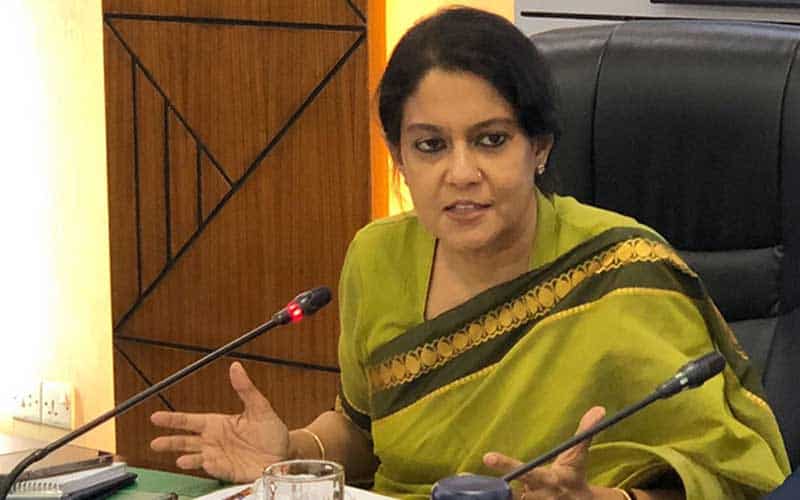
Environment, Forest and Climate Change Adviser Syeda Rizwana Hasan today said carbon trading systems must work not only as mitigation tools but also as channels for investment and technology transfer.
Speaking at a workshop titled “Business Forum on Joint Crediting Mechanism (JCM) Project Matchmaking and Advancing Article 6 Implementation in Bangladesh” at the Department of Environment, she warned that even full adaptation financing cannot guarantee the protection of Bangladesh’s coastal regions without stronger mitigation efforts.
She said adaptation has limits, and long-term climate resilience ultimately depends on effective mitigation. The event was organised in collaboration with Japan’s Ministry of the Environment.
Rizwana welcomed the revised JCM rules aligned with Article 6 of the Paris Agreement and highlighted Bangladesh’s pre-launch of its first national carbon market framework at COP30. She said the framework will offer regulatory clarity, authorisation guidelines, and a predictable structure for foreign investors, while calling for wider stakeholder consultation before its finalisation.
Referring to Bangladesh’s updated NDC targets—6.39% unconditional and 13.92% conditional emission reduction by 2035—she urged the Department of Environment to prepare a clear implementation roadmap. “Submitting NDCs is not enough; they must be backed by action plans,” she noted, asking ministries to develop sector-wise strategies.
The adviser stressed increased private sector involvement, saying export-oriented industries often adopt sustainable practices faster due to supply-chain requirements. She urged businesses to look beyond tree-plantation CSR and support renewable energy, energy efficiency, resilient agriculture and nature-based solutions.
She also advised careful oversight of waste-to-energy initiatives, calling for advanced technology, strict monitoring, compliance assurance, proper site selection, and public disclosure of performance data.
Commenting on slow global climate negotiations, Rizwana said Bangladesh—repeatedly hit by climate-related disasters—cannot wait indefinitely for meaningful international cooperation. She criticised inadequate support from developed nations but described Japan as a positive exception for its long-standing contributions in technology, climate action and environmental cooperation.
At the event, Rizwana and Keitaro Tsuji, Director of the JCM Office at Japan’s Ministry of the Environment, launched the Article 6 Guidebook for the Private Sector, developed with technical support from IGES. The guidebook aims to help businesses identify viable mitigation projects, access global partnerships, and engage in emerging carbon markets.
She also said Bangladesh and Japan are preparing to sign a Memorandum of Cooperation to support Bangladesh’s environmental initiatives, calling it a major step toward long-term bilateral collaboration.
Senior officials including Mohammad Navid Shafiullah, Additional Secretary (Climate Change); Dr Md Kamruzzaman, Director General of the Department of Environment; and representatives from MOEJ, IGES, JBCCI and DoE also spoke at the programme.
The forum brought together government agencies, private companies, financial institutions and Japanese organisations for discussions on renewable energy, green technologies, energy efficiency and Article 6-linked investment opportunities.








-20260410080037.webp)





-20260409084519.webp)

-20260409083432.webp)