

Iranian state television announced early Monday that Mojtaba Khamenei, the second son of the country’s slain supreme leader Ayatollah Ali Khamenei, has been appointed as Iran’s new supreme leader, marking a major political transition amid the ongoing regional conflict.
Mojtaba Khamenei, 56, had long been considered a possible successor to his father, even before the elder Khamenei was killed in an Israeli strike at the start of the war. Despite his influence within Iran’s political and religious establishment, he has never held elected office or been formally appointed to a government position.
Throughout his father’s leadership, Mojtaba was widely believed to wield significant influence behind the scenes, particularly within the supreme leader’s office and among conservative political networks. Analysts say he cultivated close relationships with senior figures in the Islamic Revolutionary Guard Corps (IRGC) and other powerful institutions that play a decisive role in Iran’s political system.
As supreme leader, Mojtaba Khamenei will oversee key national decisions, including military strategy, with Iran’s powerful paramilitary Revolutionary Guard directly answering to him.
His appointment highlights the structure of Iran’s political system, in which the country’s highest authority is selected through the clerical establishment rather than through direct elections. The issue of succession has historically been highly sensitive in Iran, and Mojtaba himself has rarely spoken publicly about the prospect of succeeding his father.
Observers say his rise could fuel debate over the emergence of a dynastic leadership structure in the Islamic Republic, drawing comparisons with the Pahlavi monarchy that ruled Iran before the 1979 Islamic Revolution. Supporters, however, argue that his longstanding ties with influential political and security institutions could help ensure continuity during a period of significant regional and domestic uncertainty.
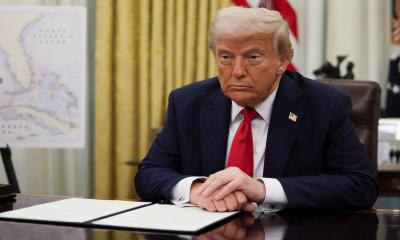
Meanwhile, U.S. President Donald Trump said Sunday that he wants a role in determining who ultimately leads Iran after the war, warning that any new leader “is not going to last long” without his approval.
Separately, the U.S. military reported that a seventh American service member has died from injuries sustained in an Iranian attack while stationed in Saudi Arabia. The previous six casualties were Army reservists killed in a March 1 strike on a port in Kuwait.
U.S. intelligence officials also believe Russia has shared information with Iran to help target American troops and assets in the Middle East.
Responding to the claim, Iranian Foreign Minister Abbas Araghchi said in an interview on Sunday that military cooperation between Tehran and Moscow “is not something new.”
At the same time, growing evidence suggests that a deadly explosion at an Iranian elementary school on February 28 was likely caused by a U.S. airstrike. The incident resulted in the highest reported civilian death toll since the war began and has drawn strong criticism from the United Nations and human rights organisations.
The United States has not accepted responsibility but said it is investigating the allegations.
The conflict continues to exact a heavy toll, with officials reporting at least 1,230 people killed in Iran, more than 300 in Lebanon and around a dozen in Israel since the war began.

-20260826082211.png)
-20260825070038.webp)





-20260824112248.jpg)

-20260823124453.webp)