
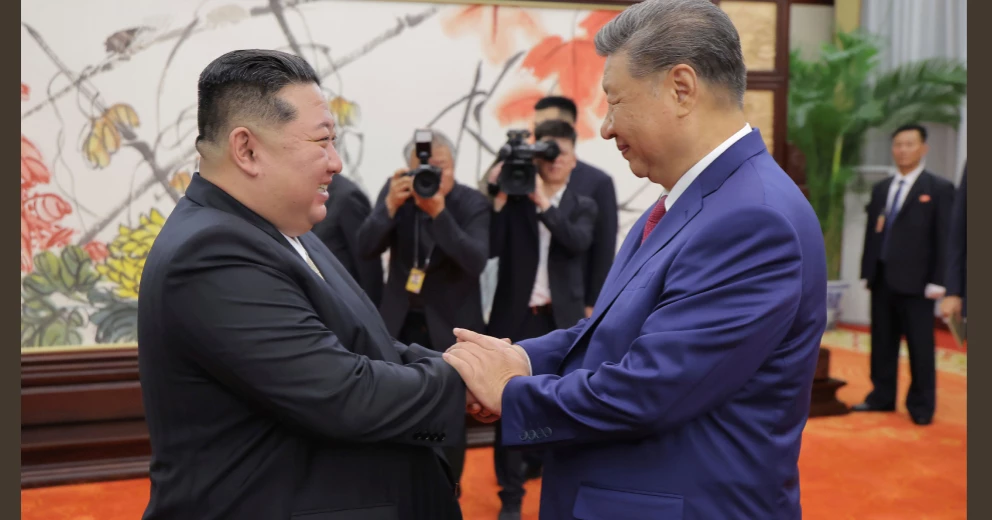
Chinese President Xi Jinping arrived in North Korea on Monday for a high-profile state visit that is expected to deepen ties between the two neighbours amid growing geopolitical tensions in the region.
The two-day trip marks Xi`s first visit to Pyongyang in seven years and comes at a time when both China and North Korea are facing separate disputes with the United States.
Xi is scheduled to hold talks with North Korean leader Kim Jong Un, their first face-to-face summit since meeting in Beijing last September during a major military parade attended by several foreign leaders, including Russian President Vladimir Putin.
According to Chinese state media, Xi was accompanied by a senior delegation that includes First Lady Peng Liyuan, Foreign Minister Wang Yi and top Communist Party official Cai Qi.
Although neither side has announced a formal agenda, analysts believe the visit carries significant political and strategic importance. Observers say Beijing is looking to reinforce its traditional relationship with Pyongyang and re-establish its influence at a time when North Korea has expanded military and economic cooperation with Russia.
China remains North Korea`s largest trading partner and most important diplomatic ally. For decades, Beijing has provided economic support to its neighbour and played a central role in efforts to manage tensions on the Korean Peninsula.
Experts say stronger influence over North Korea could also give Xi additional leverage in future dealings with the United States. The visit comes shortly after Xi held separate meetings with both President Donald Trump and Vladimir Putin in Beijing. Another Xi-Trump meeting is expected during Xi`s planned visit to the United States later this year.
In an article published in North Korea`s state newspaper, Xi called for closer strategic cooperation between the two countries and urged joint efforts against what he described as hegemonic and coercive politics.
Analysts believe China may offer additional economic assistance during the visit, including agricultural support, tourism cooperation and new economic projects. Such measures could help North Korea reduce its growing dependence on Russia.
The visit also comes as North Korea continues to expand its nuclear programme. Last week, Kim unveiled a new facility linked to nuclear material production and pledged to increase the country`s nuclear capabilities at a much faster pace.
Pyongyang has repeatedly rejected calls to abandon its nuclear weapons programme and has instead sought international recognition as a nuclear-armed state. North Korean officials have argued that denuclearisation is no longer a realistic option.
Meanwhile, South Korean President Lee Jae Myung said North Korea is believed to be producing enough nuclear material each year for multiple nuclear weapons and is making progress in long-range missile technology.
Since talks between Kim and Trump collapsed in 2019, North Korea has continued developing its military capabilities while refusing renewed offers of dialogue from Washington and Seoul.
Analysts say Kim may eventually seek negotiations focused on arms reductions rather than complete denuclearisation, hoping to secure sanctions relief and other concessions while retaining part of his nuclear arsenal.




-20260725074113.jpg)