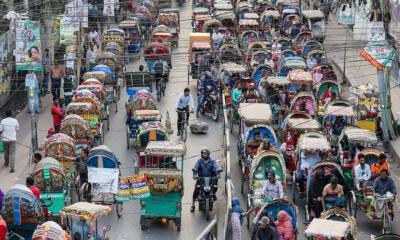

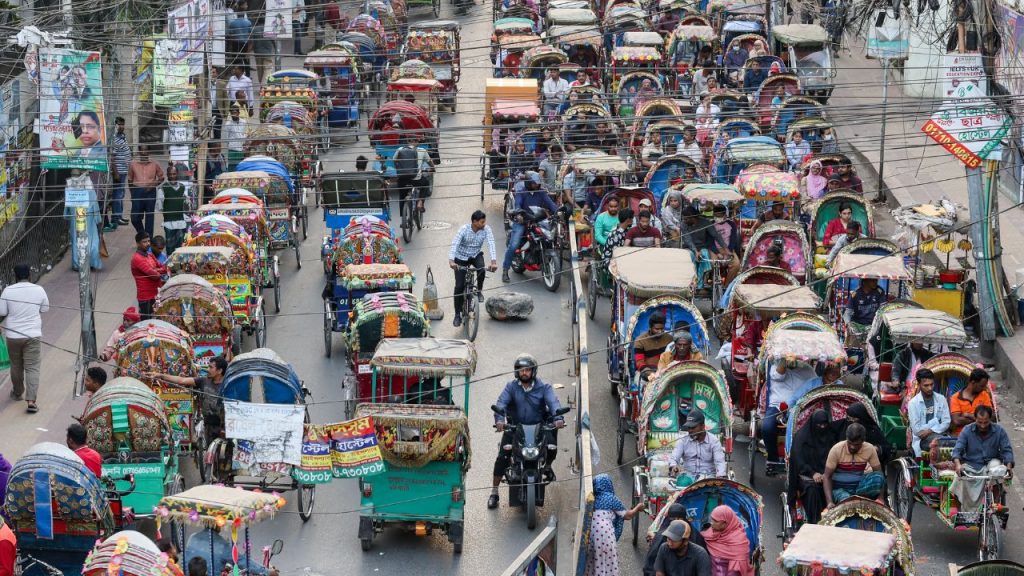
The government has taken a new initiative to bring order to Dhaka’s roads by curbing the unregulated movement of battery-run rickshaws. Under a proposed policy, the capital will be divided into eight zones, with battery-run rickshaws allowed to operate only within their designated areas.
Under the plan, rickshaws in each zone will be identified by a separate color. Each rickshaw will also be digitally registered through a permanent QR code. Scanning the code will provide information about the driver and owner. A rickshaw registered in one zone will not be allowed to enter another. This will make it easier to identify vehicles operating outside their designated areas as well as unregistered rickshaws.
The Ministry of Local Government and the two city corporations are jointly working to implement the initiative. Dhaka South City Corporation Administrator Abdus Salam said that surveys and work to determine the zones have already begun.
He said every rickshaw would carry a permanent QR code, which could be scanned to access information about the driver and owner. Under the digital system, action would be taken if a rickshaw from one zone entered another area.
State Minister for Local Government, Rural Development and Cooperatives Mir Shahe Alam said the government would not ban battery-run rickshaws outright but would instead bring them under a regulatory framework. No zone would be allowed to have more rickshaws operating than the number fixed for that area.
He said the government’s intention was not to deprive drivers of their livelihoods. However, there would be no compromise when it came to road safety and traffic discipline.
The government is also planning changes to how battery-run rickshaws are charged. It is considering banning the use of electricity from the national grid to charge rickshaws through residential or commercial connections and introducing solar-powered charging stations instead. Discussions are underway with private entrepreneurs on the matter.
For years, residents have complained about the reckless operation of battery-powered rickshaws, from major roads to narrow lanes across the capital. Many drivers do not have valid licenses or operate outside the traffic regulations, and these vehicles are often blamed for accidents and traffic congestion. There have also been allegations that batteries are being charged at illegal garages using electricity from the national grid.
Urban planners have welcomed the government’s initiative but say effective implementation will be a major challenge. They believe battery-run rickshaws should be restricted to local roads rather than major thoroughfares, while strict monitoring should be ensured at the boundaries between zones.
Mozammel Haque Chowdhury, secretary-general of the Passengers’ Welfare Association, has also stressed the need to formulate a policy for these vehicles as soon as possible. He said that registering rickshaws through city corporations, municipalities and upazila councils and issuing drivers’ licenses for a nominal fee could increase government revenue while also helping restore discipline on the roads.


-20260815175025.webp)