

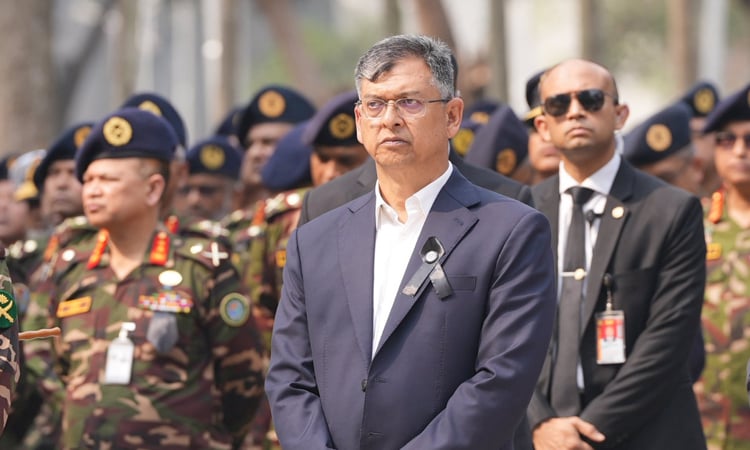
Home Minister Salahuddin Ahmed on Wednesday described the 2009 Pilkhana killings as a planned attempt to weaken the Bangladesh Army and destabilise the country, assuring that justice would be delivered for the victims and their families.
Speaking to reporters after placing wreaths at the Banani Military Graveyard on the occasion of National Martyred Army Day, he said the government is committed to ensuring accountability for one of the most brutal incidents in the country’s history.
“I assure the nation and the families of the martyrs that justice will be ensured,” the home minister said, adding that steps are also being taken to prevent such a tragedy from happening again.
Responding to questions about a fresh probe into the BDR carnage, Salahuddin clarified that the government would not form a new investigation commission.
Instead, it will move forward with implementing the recommendations of the national independent commission formed by the immediate past interim government.
He said the commission, made up of experienced and competent individuals, had submitted 70 recommendations. “All the recommendations will be implemented in phases,” he added.
The home minister also said several appeals related to the Pilkhana cases are currently pending before the Appellate Division and expressed confidence that the judicial process would reach its conclusion.
Referring to the motive behind the killings, Salahuddin said the perpetrators were influenced by forces opposed to Bangladesh’s independence and sovereignty.
“Their objective was to undermine the army and weaken the state,” he said.
The BDR carnage took place on February 25–26, 2009, at the then Bangladesh Rifles headquarters in Pilkhana, Dhaka. During the 33-hour mutiny, 74 people were killed, including the BDR director general and his wife, 57 army officers, two officers’ wives and several civilians.
















-20260824112248.jpg)




-20260828064640.webp)