
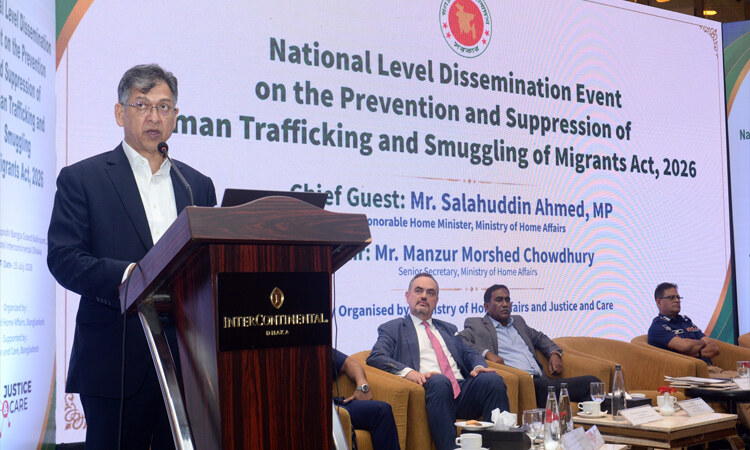
Home Minister Salahuddin Ahmed on Wednesday said the Prevention and Suppression of Human Trafficking and Migrant Smuggling Act, 2026 will significantly strengthen Bangladesh`s efforts to combat human trafficking and migrant smuggling, particularly crimes carried out through digital platforms and modern technology.
Speaking at the National Dissemination Meeting on the new law at Hotel InterContinental Dhaka, the minister said Bangladesh has modernised its legal and institutional framework to address the changing tactics of transnational trafficking networks.
He said the government remains committed to tackling human trafficking through stronger legislation, improved institutional coordination and a victim-centred criminal justice system.
The event was jointly organised by the Ministry of Home Affairs and Justice and Care Bangladesh.
Salahuddin said the new law clearly differentiates between human trafficking and migrant smuggling, strengthens investigation and prosecution procedures, enhances protection for victims and witnesses, expands international cooperation in line with global standards and recognises the principle that trafficking victims should not be punished for offences committed as a consequence of being trafficked.
Participants at the meeting stressed the importance of stronger coordination among government agencies and continued cooperation with international partners to ensure effective implementation of the law, dismantle organised trafficking networks and bring offenders to justice.
Justice and Care Bangladesh Country Director Mohammad Tarikul Islam presented the background, objectives and key provisions of the legislation.
The programme, chaired by Home Ministry Senior Secretary Manzur Morshed Chowdhury, was attended by Foreign Secretary Asad Alam Siam, British High Commissioner Sarah Cooke, US Ambassador Brent T. Christensen, Inspector General of Police Md. Ali Hossain Fakir, Border Guard Bangladesh Director General Major General Mohammad Ashrafuzzaman Siddiqui, Bangladesh Coast Guard Director General Rear Admiral Md. Ziaul Hoque, and senior representatives from law enforcement agencies, the judiciary, diplomatic missions, UN bodies, development partners and civil society.


-20260824112248.jpg)





-20260824063249.webp)
-20260823124453.webp)