
Commerce Minister Khandaker Abdul Muktadir has said that Bangladesh’s markets will no longer be controlled through syndicates.
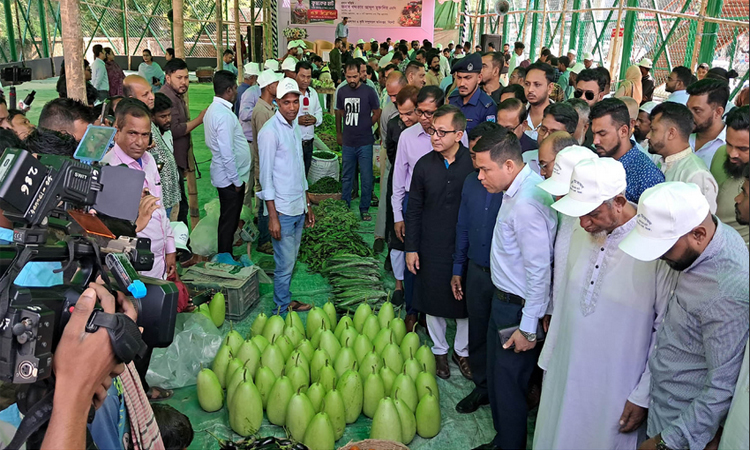
“We will erase the notion that markets are controlled through syndicates,” he said while speaking at the inauguration of the country’s first direct farmers’ sales centre, ‘Krishoker Haat’, in the Tilagor area of Sylhet on Saturday.
The initiative was jointly launched by the district administration and the Department of Agricultural Extension.
Officials said the farmers’ market has been introduced to reduce the influence of middlemen and syndicates, allowing producers to sell their goods directly to consumers.
At the event, the minister said the government plans to integrate the country’s supply chain into an AI-based monitoring system to help stabilise the markets for imported and essential goods.
He also said the activities of the Trading Corporation of Bangladesh (TCB) would be expanded further. He added that annual government subsidies of around Tk 3,200–3,300 crore allocated for Trading Corporation of Bangladesh operations would be gradually reduced alongside efforts to improve efficiency.
The minister further said district administrations across the country would be directed to ensure that farmers can directly sell their produce to consumers at least one day a week.
He also announced that Prime Minister Tarique Rahman is scheduled to inaugurate the excavation of the Banshia canal in Sylhet on May 2.
According to the Sylhet district administration, the ‘Krishoker Haat’ has been introduced as a pilot initiative aimed at reducing the dominance of intermediaries in agricultural markets.
Officials said the market will operate daily at a designated spot in Tilagor Point, where local farmers can sell their produce directly to consumers without middlemen.
They added that the initiative is designed to shorten the supply chain between farmers and consumers, ensuring fair prices for producers while allowing buyers to access fresher produce at lower costs.
At present, agricultural products typically pass through four to five layers of intermediaries before reaching consumers, which increases prices while reducing the share received by farmers. The new initiative is expected to reduce such inefficiencies and improve price fairness for both producers and consumers.






















-20260828064640.webp)