

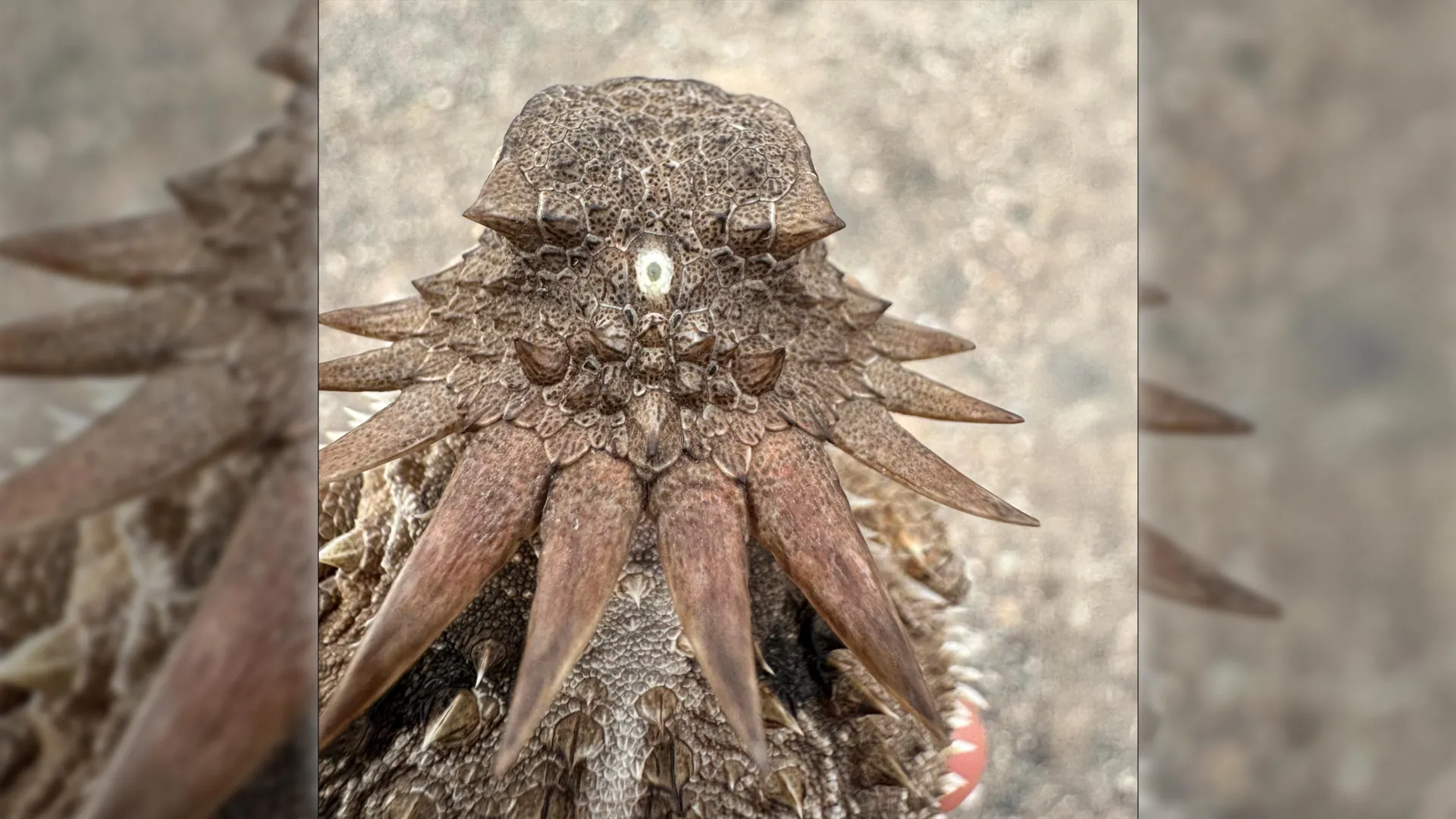
Humans and other vertebrates may owe their vision to a tiny marine creature that lived around 600 million years ago and possessed a single eye-like organ, according to a new study that challenges long-held ideas about the evolution of eyesight.
Researchers from Lund University in Sweden and the University of Sussex suggest that the distant ancestor of modern vertebrates including humans passed through a "Cyclops-like" stage before developing the paired, image-forming eyes seen in animals today.
Rather than evolving two eyes from scratch, the researchers believe an ancient light-sensitive organ located at the centre of the creature`s head was gradually adapted over millions of years into the sophisticated visual system found in modern vertebrates.
"The results are a surprise. They turn our understanding of the evolution of the eye and the brain upside down," said Dan-E Nilsson, Professor Emeritus of Sensory Biology at Lund University.
The researchers say the ancient ancestor was a tiny worm-like animal that lived in the ocean and fed by filtering plankton from seawater. Because it spent much of its life largely stationary, complex vision became less important for survival.
They believe the animal may originally have had two eyes or two clusters of light-sensitive cells—but these gradually disappeared as they became unnecessary.
What remained was a simple light-detecting organ positioned in the middle of its head.
Although the primitive structure was incapable of producing detailed images, it likely enabled the creature to detect changes between day and night and maintain its orientation in the water.
As the descendants of the creature gradually evolved into more active swimmers, scientists believe the need for advanced vision returned. Instead of creating an entirely new visual system, evolution appears to have repurposed parts of the ancient central eye, eventually giving rise to the paired eyes that characterise vertebrates today.
The research also provides a possible explanation for why vertebrate eyes developed differently from those of insects and squid.
Unlike insects and cephalopods, whose eyes develop from skin tissue, vertebrate eyes originate as part of the developing brain.
Their retina the light-sensitive layer at the back of the eye, forms directly from brain tissue before transmitting visual signals through the nervous system.
To reach their conclusions, the researchers compared light-sensitive cells across a wide range of animal groups, examining their structure, function, location and neural connections.
The researchers also suggest that remnants of the ancient central eye may still survive in humans in the form of the pineal gland, a small organ located deep inside the brain.
Although the pineal gland no longer plays a role in vision, it regulates the body`s internal clock by producing melatonin, the hormone responsible for controlling sleep and wake cycles in response to light.
In many other vertebrates, the pineal organ can still detect light directly.
In humans, however, light information reaches the gland indirectly through signals transmitted from the eyes.
"It’s mind-boggling that our pineal gland’s ability to regulate our sleep according to light stems from the cyclopean median eye of a distant ancestor 600 million years ago," Nilsson said.
The researchers say the findings offer fresh insight into one of evolution`s most remarkable transformations, suggesting that the sophisticated human eye may have evolved from a simple light-sensing organ that first appeared hundreds of millions of years before the earliest vertebrates.
The research was conducted by scientists from Lund University and the University of Sussex and was reported by ScienceDaily.














-20260814134111.webp)