

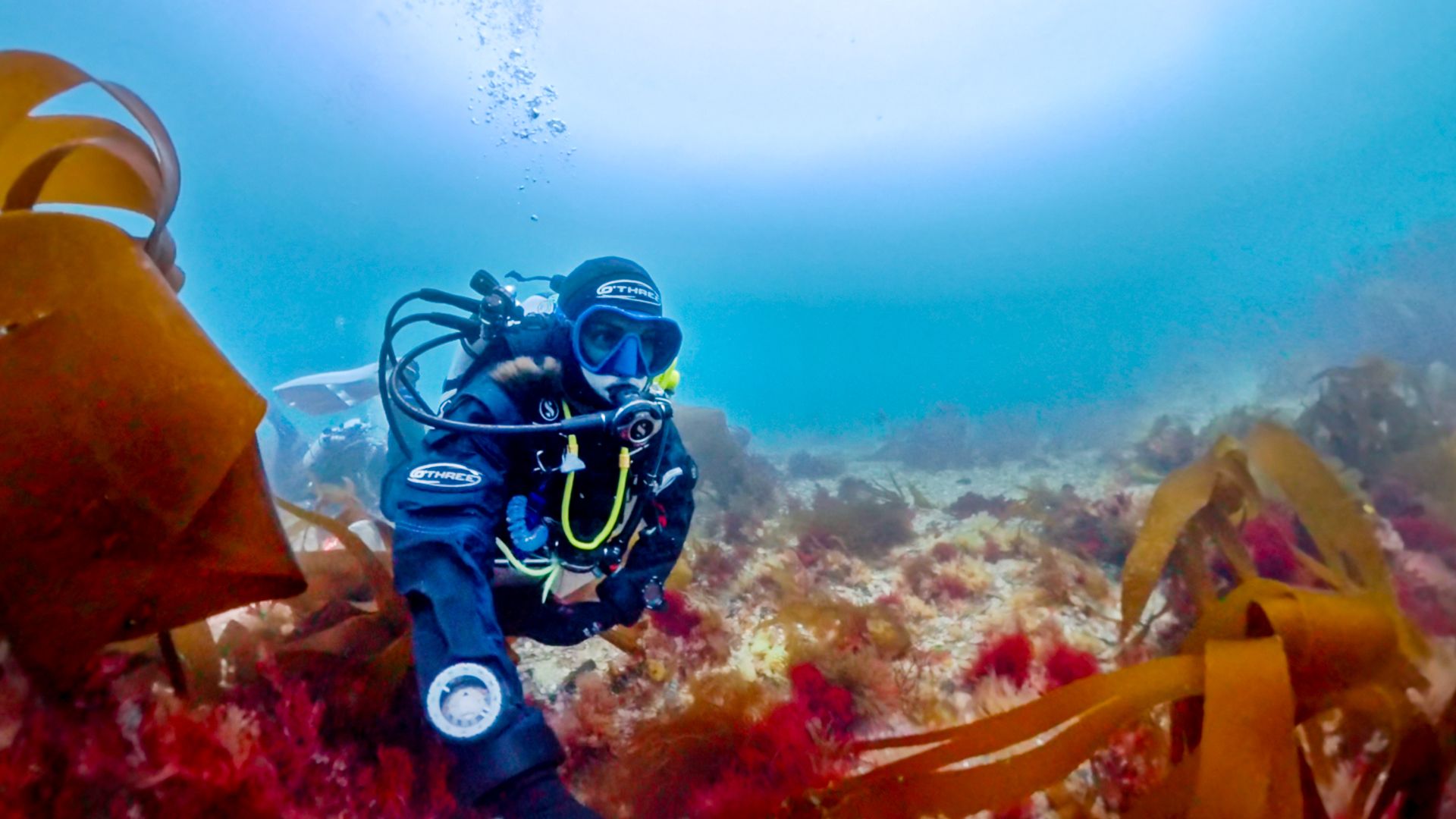
A mystery that puzzled scientists for more than four decades has finally been solved after researchers confirmed the discovery of a rare new seaweed species hidden in the UK`s ancient underwater maerl beds.
The breakthrough ends a 40-year search led by Professor Christine Maggs, who first noticed the tiny pink-striped seaweed while carrying out PhD research in the 1980s.
She believed it was an unknown species but could never find enough material to prove it.
Maerl beds are made up of hard, coral-like seaweed and provide an important habitat for many marine species.
Over the years, Prof Maggs occasionally came across small traces of the seaweed, but the samples were too small to allow proper identification.
The search finally paid off two years ago when researchers surveying maerl beds off the coast of Cornwall found a specimen that closely matched the mysterious plant.
Prof Maggs preserved the sample in a wine fridge, using the cool, dark conditions to keep it alive and help it grow before carrying out DNA analysis.
"I just kept hoping that one day I would find out. It`s been more than four decades," she told the BBC.
DNA testing confirmed that the seaweed is a previously unknown species.
A specimen has now been added to the collection of the Natural History Museum.
The discovery was made during a Natural England project to monitor the condition of Cornwall`s maerl beds.
Scientific diver Lucy May described the underwater habitat as a remarkable place filled with marine life.
"It`s magical. You feel completely surrounded by nature," she said.
Researchers regularly encounter spider crabs, starfish, king scallops and goby fish while surveying the area.
Marine biologist Francis Bunker, who collected the key sample, said he spotted the tiny pink-banded seaweed while closely examining marine plants underwater with a magnifying glass.
Suspecting it could be the long-lost species, he collected several samples and sent them to Prof Maggs.
Because the seaweed was so small, it first had to be grown before scientists could carry out DNA sequencing.
"Getting the genetic information was essential," Prof Maggs said.
"That`s why solving this mystery has taken 40 years."







-20260823105444.webp)


























-20260817061349.jpg)