

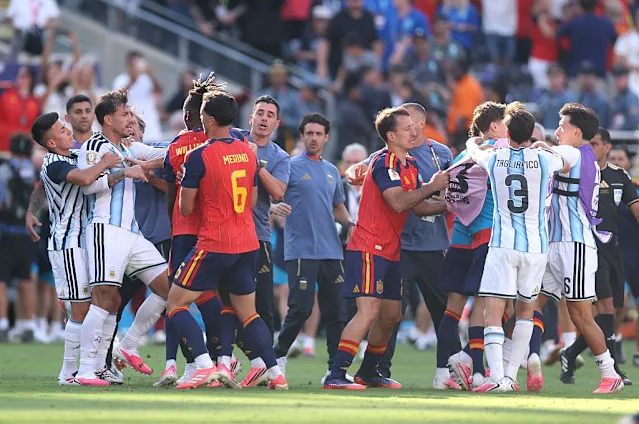
Argentina`s conduct during the 2026 FIFA World Cup has drawn widespread criticism following Sunday`s 1-0 final defeat to Spain, with former players, media figures and fans accusing the defending champions of poor sportsmanship and aggressive play.
The criticism intensified after a heated World Cup final in which several confrontations broke out on the pitch. Commentators also questioned Argentina`s behaviour after the final whistle, including players turning their backs while Spain lifted the trophy.
The New York Times described Argentina`s display as "tetchy, petulant and distasteful", while former Germany international Thomas Hitzlsperger wrote on X that the team had shown unacceptable sportsmanship. British television personality Piers Morgan also criticised Argentina, accusing the players of repeatedly targeting Spanish opponents with rough challenges.
Throughout the tournament, Argentina also faced accusations of benefiting from favourable refereeing decisions, including penalties and disciplinary calls, further fuelling criticism from rival supporters.
However, many Argentines dismissed the backlash, arguing that their team`s combative style reflects passion rather than unsporting behaviour.
"We`ve always been criticised, and we`re used to it," said Maximiliano Heredia, a construction worker who joined thousands of supporters welcoming the squad home in Buenos Aires. "But our players always give everything they have."
Others suggested Argentina`s confidence is often misunderstood abroad.
"They confuse arrogance with pride," said one supporter, while lawyer Leo Simone argued that Argentines are frequently judged harshly because of their outspoken personalities.
The debate has also spread across social media, where some Argentine supporters embraced the criticism.
Journalist Pedro Rosemblat wrote on Instagram that Argentina`s defiant attitude has long irritated critics, adding that labels such as "cocky", "cheaters" and "dirty" have become badges of honour for many fans.
Not everyone in Argentina defended every aspect of the team`s behaviour.
Veteran sports journalist Ezequiel Fernandez Moores acknowledged that some criticism was justified, saying local football culture often celebrates provocation and bravado in ways that are misunderstood internationally.
He also said Argentina`s players should not have turned their backs while Spain received the World Cup trophy.
The tournament also reignited debate over racism involving some Argentine supporters.
FIFA condemned racist abuse directed at a Black American content creator during the World Cup after an Argentine fan made offensive remarks during a livestream.
Hollywood actor Samuel L. Jackson also criticised Argentina in an Instagram post, urging Black fans not to support the team because of what he described as the country`s history of racism.
Argentina has previously faced criticism over racist chants and incidents involving football supporters, including songs targeting France`s Black players and discriminatory behaviour at club matches.
Sociologist Ivan Schuliaquer of Argentina`s National University of San Martin said racism linked to football should not be ignored but cautioned against using those incidents to define Argentine society as a whole.
He acknowledged that racism exists and deserves to be confronted, while arguing that many of the countries criticising Argentina continue to struggle with racial discrimination themselves.
Despite the controversy, Argentina`s players received a warm reception from supporters after returning home, with thousands gathering in Buenos Aires to applaud the team following its run to a second consecutive World Cup final.

-20260824112248.jpg)








-20260824063249.webp)
-20260823124453.webp)










-20260817061349.jpg)