

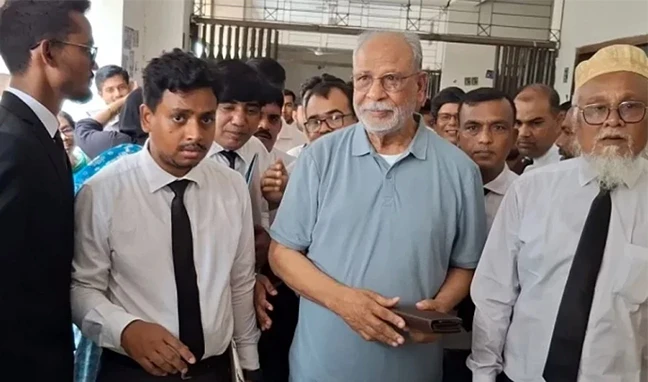
The International Crimes Tribunal has ordered former minister Abdul Latif Siddiqui to be shown arrested and sent to jail in a crimes against humanity case linked to the massacre surrounding the Hefazat-e-Islam rally at Shapla Chattar in Motijheel, Dhaka, on May 5, 2013.
A three-member International Crimes Tribunal bench, headed by Justice Nazrul Islam Chowdhury, issued the order on Thursday after hearing a prosecution petition.
Latif Siddiqui was produced before the International Crimes Tribunal at 1pm on Thursday.
According to the prosecution, an arrest warrant had already been issued against Latif Siddiqui in the case filed over the Shapla Chattar incident. The Detective Branch (DB) of the Dhaka Metropolitan Police (DMP) arrested him from his Gulshan residence on Wednesday evening to execute the warrant.
Earlier, on July 27, Tribunal-2 took cognizance of the formal charges submitted by the prosecution and issued arrest warrants against 31 people, including ousted prime minister Sheikh Hasina. The tribunal also directed 10 others to appear before it and fixed August 16 for the next hearing in the case.
Eight accused are currently in custody in the case. They are former minister Dr Dipu Moni, former state minister for home affairs Shamsul Haque Tuku, Major General (retd) Ziaul Ahsan, former inspector general of police (IGP) AKM Shahidul Haque, Shahriar Kabir, president of the advisory council of Ekattorer Ghatak Dalal Nirmul Committee, former deputy inspector general (DIG) Abdul Jalil Mondal, journalist Farzana Rupa, and Mozammel Babu.
Hasanul Haq Inu is also in jail after being convicted in another case, while Abdur Razzaq has been arrested in the same case. The remaining accused are absconding.
The formal charges in the case include two allegations of crimes against humanity. The first allegation relates to the killing of 32 people at Shapla Chattar on May 5, 2013.
The second allegation involves the killing of 20 people, including Sadek Mia, in Narayanganj’s Siddhirganj on May 6, along with deaths reported from different parts of the country.
The charges further include allegations that several people, including Rashedul Islam and Abu Yusuf, were shot with the intention of killing them and sustained serious injuries as a result of the attacks and torture.
The prosecution said the incidents constitute crimes against humanity, including genocide, murder, attempted murder, torture, and persecution based on political and religious identity.



-20260823124453.webp)

-20260823105444.webp)
















-20260817061349.jpg)