
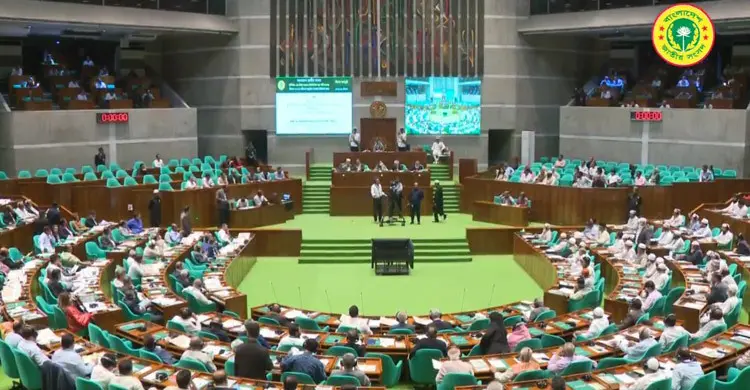
The Finance Bill 2026 has been passed in the national parliament with amendments, including the abolition of the provision allowing the whitening of black money, the setting of a tax-free income threshold at Tk 4 lakh for individuals, and the removal of the requirement for a TIN number to open a bank account.
The bill was passed by voice vote in the session on Monday afternoon, chaired by Speaker Hafiz Uddin Ahmed, after Finance Minister Amir Khasru Mahmud Chowdhury placed it for final approval.
Prior to its passage, the bill was discussed at length in parliament, including proposals for public opinion testing and general principles. Several MPs, including independent lawmaker Rumeen Farhana from Brahmanbaria-2, raised concerns over the large budget deficit, tax and VAT burden, corruption in the banking sector, mismanagement in health and education, and the feasibility of loan assurances from the prime minister’s visit to China, calling for further scrutiny of the bill.
Following the discussion, the bill was passed with multiple amendments.
In his closing budget speech after the passage of the bill, the finance minister said the current government had inherited a severely weak economy and a fragile institutional framework. He expressed optimism about moving the country toward sustainable growth, saying that strong leadership, robust institutions, an efficient public administration, and active citizen participation would help overcome challenges.
He added that the government is gradually shifting from a debt-dependent economy to an investment-driven one, where private initiative, innovation, and employment creation will be the main drivers of growth. Ensuring equitable distribution of development benefits and proper recognition of merit and hard work, he said, remain key government goals.
Thanking MPs for their detailed and constructive debate on the budget, he said their views reflected public expectations. He also welcomed criticism from economists, businesses, and the media, saying the budget is not merely an account of income and expenditure but a framework for restoring economic stability, boosting investment, and ensuring social justice.
Responding to questions about inflation at 7.5% and GDP growth at 6.5%, the minister said the economy has come under pressure due to long-term policy failures, corruption, money laundering, exchange rate manipulation, and geopolitical instability. However, he said positive trends in agriculture, industry, services, and remittances, along with government policy measures, would help address the crisis.
On revenue targets, he said the government aims to expand the tax base instead of raising tax rates. Tax policy and tax administration are being separated to improve transparency. He also said strict action will be taken against tax evasion, while small businesses, including traditional markets and small grocery shops, will be fully exempt from the proposed unified VAT system.
He further said the National Board of Revenue (NBR) collected over Tk 4 lakh crore in the current fiscal year for the first time. In the next fiscal year, operating expenditure will be reduced while development spending will increase. Development expenditure is projected to rise to 33.7% of the total budget in 2026–27, up from 27.27% in the current fiscal year, while operating expenditure is expected to decline from 72.73% to 66.3%.
Criticising excessive borrowing by the previous government, the minister said total government debt currently stands at around Tk 21 lakh 44 thousand crore, equivalent to 38.61% of GDP. Of this, domestic debt is Tk 11 lakh 95 thousand crore and external debt Tk 9 lakh 49 thousand crore. He said the debt burden has created significant financial pressure on the current administration.
To reduce reliance on bank borrowing, he said the government plans to cut bank borrowing by Tk 6,000 crore, list state-owned enterprises on the stock market, and expand bond and equity financing. He also mentioned initiatives to establish private investment funds in Hong Kong, London, and New York.
The finance minister said the government has taken a strict stance against financial crimes. As of May 2026, assets worth Tk 72,343 crore have been frozen or suspended domestically and abroad in 11 priority cases.
He added that 23 mutual legal assistance requests have been sent to 13 countries to recover laundered money, and agreements with Malaysia and Hong Kong are being finalised.
He also said legal action has been initiated against six major loan defaulters, and more than 15 affected banks have signed over 60 confidentiality agreements with international asset recovery firms.











-20260824112248.jpg)


-20260828064640.webp)