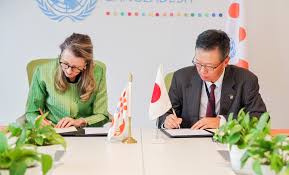
The government of Japan has approved JPY 500 million (approximately $3.2 million) in fresh funding for the Rohingya humanitarian response in Bangladesh, reaffirming its continued commitment to protecting displaced women and adolescents.
The funding will be channelled through the United Nations Population Fund (UNFPA) to sustain essential health and protection services in Cox’s Bazar and Bhasan Char over the next two years.
Japanese Ambassador to Bangladesh Saida Shinichi said the assistance aims to improve the living conditions of Rohingya refugees and host communities.
“Japan remains firmly committed to protecting the most vulnerable, particularly women and adolescents affected by displacement,” he said on Tuesday. “Through our partnership with UNFPA, we aim to ensure continued access to essential health and protection services despite growing humanitarian and funding challenges.”
UNFPA Representative in Bangladesh Catherine Breen Kamkong described the contribution as timely, noting that women and girls face increasing risks amid funding shortages.
“This support will allow us to sustain life-saving services that protect the health and dignity of women and adolescents who would otherwise face devastating gaps in care,” she said.
Addressing urgent gaps
The Rohingya crisis remains one of the world’s most protracted humanitarian emergencies, with more than one million refugees living in Cox’s Bazar alongside vulnerable host communities. Since 2024, an estimated 150,000 new arrivals — more than half of them women and girls — have added further pressure to already overcrowded camps.
The 2025–2026 Joint Response Plan for the Rohingya Humanitarian Crisis is significantly underfunded, leading to the closure of six government-run health facilities, a 16 percent cut in midwifery staff, and a more than 50 percent reduction in gender-based violence (GBV) case managers.
Officials said Japan’s latest contribution will help maintain round-the-clock emergency obstetric care, GBV case management and mental health services for about 180,000 direct beneficiaries.
Building on past support
The new funding builds on earlier Japan-backed initiatives that enabled over 38,000 women and girls to access essential services at UNFPA-supported facilities in Cox’s Bazar and Bhasan Char.
In Bhasan Char, Japanese support helped operationalise a 20-bed hospital, reducing critical referrals and contributing to low maternal mortality rates. It also expanded Women Friendly Spaces and community-led centres that provide survivor-focused GBV services and empowerment programmes for adolescents.
Since 2017, Japan has contributed more than $250 million to the Rohingya response in Bangladesh through UN agencies and NGOs, making it one of the largest and most consistent donors to the crisis.
Officials said the renewed partnership underscores continued international solidarity in safeguarding the health, protection and dignity of displaced women and girls.







-20260429103203.jpg)