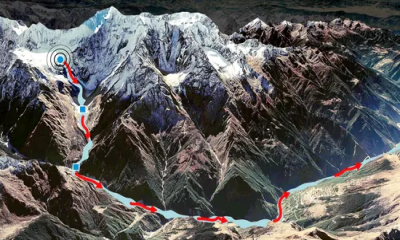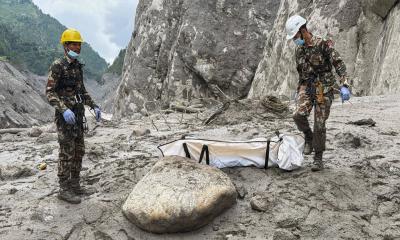

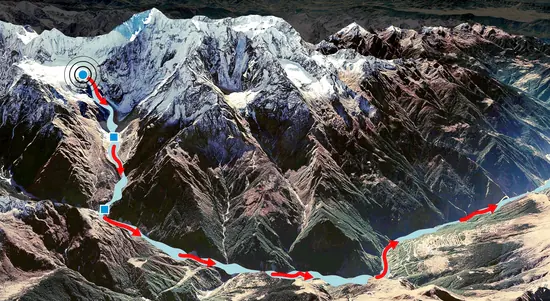
An unusual heatwave hit a mountain glacier in Nepal days before a massive collapse triggered deadly floods in Nepal and China on August 26, according to a new analysis of meteorological data.
Temperatures at the glacier, located about 5,200 metres above sea level, averaged around 5°C between August 21 and 26. The figure was the highest recorded for the period in more than 55 years of available data.
The temperature pattern was reconstructed by Robert Rohde, chief scientist at California-based independent research organisation Berkeley Earth.
Rohde found that the average temperature at the collapse site during those six days had increased by about 1.8°C compared with the mid-20th century. He estimated that without the additional warming caused by climate change, a similar temperature pattern would probably occur only once in several thousand years.
The collapse also occurred during the Langtang region’s fourth-hottest summer since records began in 1970, according to an analysis of data from Europe’s Copernicus climate monitoring programme.
The extreme heat may have contributed to the disaster by weakening the mountain slopes. French climatologist Valerie Masson-Delmotte said high temperatures could help thaw permafrost and contribute to the combined collapse of slopes and glaciers.
Permafrost acts as a layer of frozen material that helps hold mountain rock together. As it thaws, slopes can become increasingly unstable.
Satellite images also showed substantial snowmelt in the days before the collapse. Etienne Berthier, a glaciologist with France’s CNRS research agency, said the resulting meltwater could have entered cracks in the mountain and helped trigger landslides.
Experts, however, caution against directly linking the high temperatures to the collapse.
“It’s not as straightforward as ‘high temperature equals collapse,’” said Kristen Cook, a geomorphologist at Grenoble Alpes University in France.
She said heat may have acted as a trigger only after the rock had already reached a critical point of instability.
Researchers are now studying small movements detected in the mountain in the years before the collapse and examining how they may have interacted with changing temperatures.
Rohde said evidence that meltwater or permafrost thaw had significantly weakened the rock near the fracture zone would provide strong evidence of a climate change link.
His analysis used data from the Copernicus programme’s ERA5 climate model, along with observations from 14 high-altitude weather stations located between nine and 140 kilometres from the collapsed glacier.